



Trip Start
Trip End
Price (CAD)
Departing On
Returning On
Without Flight
Call to speak with one of our Tour Experts 1-877-230-8747
-
 Jairus Mausx7365
Offline
Jairus Mausx7365
Offline
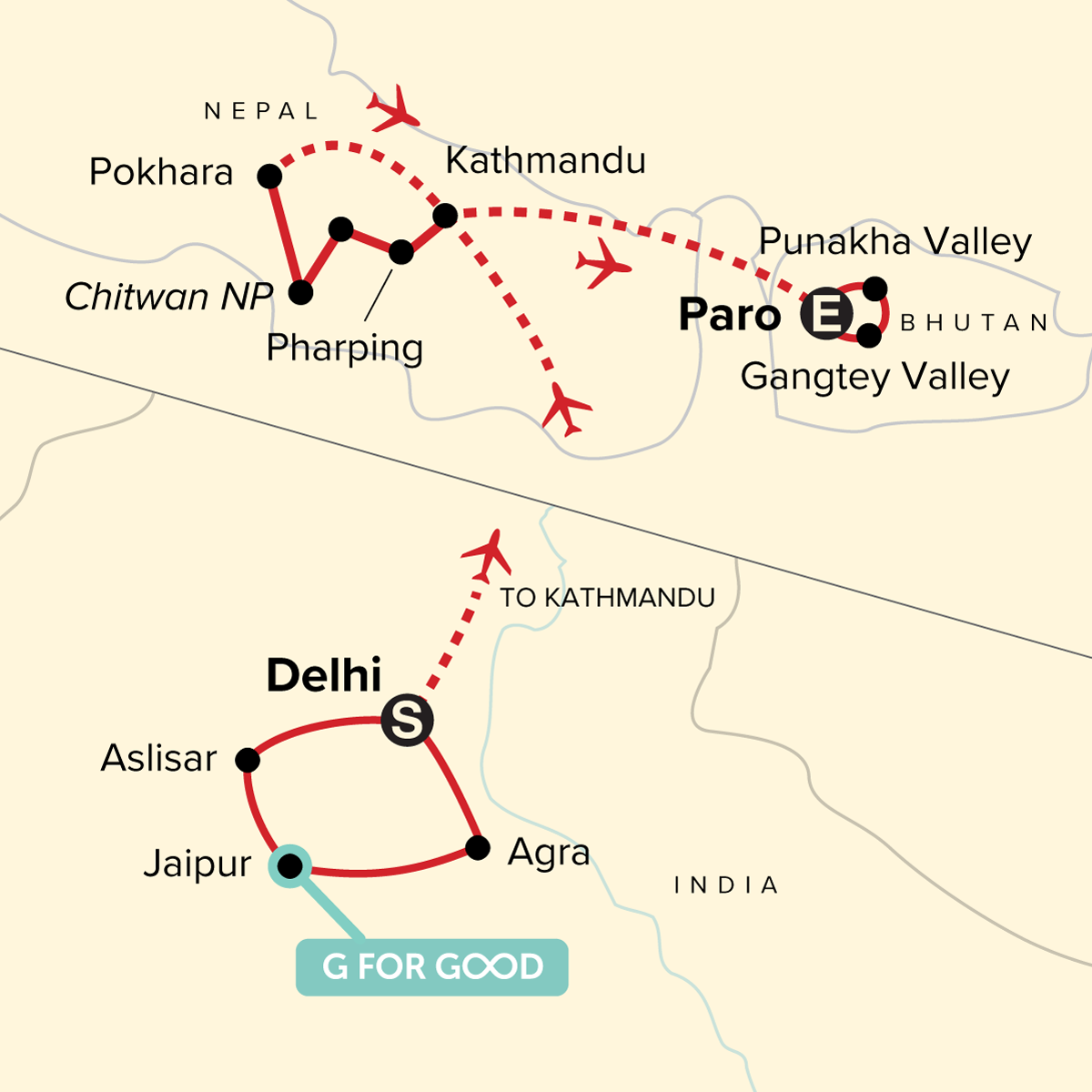
- Day 1 Delhi Arrive at any time; your arrival transfer is included through Women With Wheels, a G Adventures–supported project. There are no planned activities until an evening welcome meeting, so check into to the hotel and enjoy the city. We highly recommend booking a pre-night in Delhi to get over your jetlag and be ready for this very busy trip.
- Day 2 Delhi - Āgra Set out to discover Delhi, the capital of India, which consists of two cities: historic Delhi and New Delhi, built by the British in the early 20th century. Explore New Delhi’s lively Paharganj district with a youth guide from the G Adventures–supported City Walk project, and hear about how the program provides opportunities to disadvantaged street youth. Then delve into the narrow, winding lanes of Old Delhi, visiting the 17th-century Jama Masjid—the largest mosque in India—and the Sikh temple Gurdwara Sis Ganj Sahib, located close to a busy shopping area. Drive to Agra this afternoon.
- Day 3 Āgra Spend the day in historic Agra, which served as the capital of the Delhi sultanate and later of the Mughal Empire. Discover the Taj Mahal, one of the New Seven Wonders of the World; widely considered the finest example of Mughal architecture, this breathtaking mausoleum was built by the emperor Shah Jahan for his favourite wife, Mumtaz Mahal. Afterward, visit the exquisite tomb of Mumtaz Mahal’s grandfather, often referred to as the “baby Taj,” and explore Agra Fort, an impressive red sandstone citadel which conceals palaces of white marble within.
- Day 4 Āgra - Jaipur Travel to Jaipur, the capital of the state of Rajasthan. On the way, stop at the magnificent Mughal city of Fatehpur Sikri, a masterpiece of red sandstone, and hear about its fascinating history. The emperor Akbar built a short-lived capital here in the 16th century to honour a Muslim saint from the village of Sikri who had predicted the birth of his son, Jehangir. Then visit the Rajasthani village of Abhaneri for a walk around the Chand Baori—an ornately decorated stepwell or water tank constructed over a thousand years ago—learning about ancient Indian methods of water conservation. Before arriving to your hotel, visit the Anoothi Project, a collective of women from a marginalised community outside Jaipur who have mastered the traditionally-male technique of block printing. Travelers will engage in a hands-on block printing experience and spend time with the women leading this experience to speak with them about the purpose of the collective and its impact on the community.
- Day 5 Jaipur Explore Jaipur, known as the “Pink City” for its rose-coloured buildings. Take a tour of the sprawling Amber Fort, the former residence of Jaipur’s Rajput rulers; and visit Hawa Mahal, or the Palace of Winds, a stunning five-story sandstone building with distinctive honeycombed windows. The next stop in Jaipur today is at Anoothi. Here, you’ll discover the artistry of traditional block printing while supporting a meaningful local women’s initiative. Tonight, consider going to the cinema to watch a Bollywood movie—a truly unique experience. Going to see a Bollywood film in India is much more than what we are accustomed to in the west. The atmosphere, energy, and pure fun (not to mention volume!) has to be experienced to be believed.
- Day 6 Jaipur - Alsīsar Start your day with a local historian and sociology scholar, diving into India’s intricate social fabric—from its ancient belief systems to its iconic architecture. Afterward, travel into rural Rajasthan and join your Expedition Leader to explore Alsisar, a village famed for its stunning heritage havelis (mansions). The evening concludes with dinner at our own haveli accommodations.
- Day 7 Alsīsar - Delhi Drive back to bustling Delhi. After checking into the hotel, enjoy the rest of the day free to explore the city. This evening, opt to join the group for a farewell dinner.
- Day 8 Delhi - Kathmandu Transfer to the airport and catch a flight to Kathmandu, the capital of Nepal. After our welcome meeting, experience a sound bath wellness demonstration and enjoy a six-course dinner featuring organic Nepali cuisine.
- Day 9 Kathmandu Spend the day exploring Kathmandu, the colourful capital of this Himalayan nation. Pay a visit to Bodhnath Stupa, the holiest Tibetan Buddhist shrine outside of Tibet, and explore the wood-carved temples, pagodas, and palaces of Bhaktapur, Nepal’s medieval capital.
- Day 10 Kathmandu - Pharping Venture to the ancient hilltop temple of Swayambhunath, decorated with vibrant prayer flags and home to troops of rhesus monkeys. Later, we’ll hear about National Geographic Grantee Chhing Lhomi’s efforts to preserve the weaving traditions of the Upper Mustang region through her work with the Himalayan Indigenous Society, a Kathmandu-based nonprofit. Then depart for nearby Pharping, known for its Buddhist pilgrimage sites, and settle into a tranquil monastery guesthouse for the night. Get an insider’s view of monastery life, and enjoy a chanting and prayer service; or opt to take a walk in the monastery’s peaceful grounds. Enjoy a cooking demonstration at local community restaurant and learn how to make Nepalese momos (dumplings). Afterwards, taste your delicious creations. Experience the serenity of a Tibetan Buddhist monastery. The monastery guest house offers comfortable accommodations in a peaceful setting with balconies and private western-style bathrooms. There are approximately 200 monks in residence following the Nyingmapa tradition. This is a new monastery (2006), and income from the guest house directly supports it.
- Day 11 Pharping - Kurintar Rise at dawn to listen to the monks’ morning chanting, and witness a stunning sunrise. Then drive to the small riverside village of Kurintar and hike to our lodge, nestled on a forested hill overlooking the Trishuli River. Opt to relax by the pool or take a guided walk through the surrounding countryside, stopping at local villages. Arrive at our remote lodge, which sits on a ridge amidst the hills overlooking sandy beaches and a river. Forests cascade down the hillsides, enclosing tiny settlements of tribal people.
- Day 12 Kurintar - Royal Chitwan National Park Today, we travel towards Chitwan National Park, Nepal’s oldest wildlife reserve and a UNESCO World Heritage site. The park is home to 68 recorded mammal species, including the one-horned rhino and the Bengal tiger, as well as hundreds of species of birds. Check in to our lodge, located on the banks of the East Rapti River. After lunch, board a traditional flat-bottomed boat for a river safari, keeping your eyes out for aquatic birds, crocodiles, and other riverine fauna. Spend two nights enjoying cultural and wildlife excursions in and around Royal Chitwan National Park (RCNP), the oldest national park in Nepal. Established in 1973, it became a UNESCO World Heritage site in 1984. Within its area of 932km² (579 mi²), RCNP is home to at least 43 species of mammals, 450 species of birds, and 45 species of amphibians and reptiles, including sambars, chitals, rhesus monkeys, tigers, and langurs.
- Day 13 Royal Chitwan National Park Spend the day exploring Chitwan National Park on a variety of excursions; activities differ depending on the season. Set out on a jeep safari through the grasslands and forests, seeking out rhinos, leopards, elephants, monkeys, and the elusive Bengal tiger. Meet with a “tiger technician” from the Nepal Tiger Trust, a nonprofit dedicated to the protection and conservation of these majestic cats. Visit a farming village bordering the park for a glimpse of rural life, and return to our lodge this evening in time for a dance performance by the local Tharu people.
- Day 14 Royal Chitwan National Park - Pokhara Drive to Pokhara, an enchanting town set on the shores of turquoise-hued Phewa Lake against a backdrop of snowcapped Himalayan peaks. Enjoy a guided walk around the city, and opt to have dinner at a popular local restaurant. Nestled in a tranquil valley at an altitude of 827m (2,713 ft), beautiful Pokhara lies on a once vibrant trade route between India and Tibet. To this day, mule trains can be seen bringing goods to trade from remote regions of the Himalayas. This enchanting city has several beautiful lakes and offers stunning panoramic views of Himalayan peaks. It's a popular place to relax and enjoy the beauty of nature.
- Day 15 Pokhara Venture to Sarangkot village early this morning and hike to the famed Sarangkot lookout to witness a breathtaking sunrise over the Annapurna Himalaya. Back in Pokhara, climb up a lush forest path to the gleaming white Peace Pagoda, built by Japanese monks after World War II. Later, visit a Tibetan refugee settlement, established by the United Nations in 1964. Learn about the history of the community on a walk through their photo gallery, and enjoy a traditional Tibetan lunch. In your free time, opt to take a boat tour of Phewa Lake.
- Day 16 Pokhara - Kathmandu Catch a flight back to the capital, Kathmandu. Enjoy time to shop in the bustling Thamel district, or choose to visit Pashupatinath Temple, the most sacred Hindu temple complex in Nepal. Enjoy free time in the afternoon for exploring. Visit the burning ghats at Pashupatinath and Swayambhunath, or the monkey temple. Kathmandu is fascinating at every turn, and some travelers prefer to just wander, seeing where the city may lead them.
- Day 17 Kathmandu - Thimphu Transfer to Kathmandu's airport for a flight past the world's highest peaks into Paro, Bhutan. Descend into Paro's emerald valley, where mountain air greets you at the steps of the plane. Clear customs, meet your guide, then travel along winding river roads to Thimphu, the only capital in the world without a single traffic light. In clear weather, the flight over the Himalayas offers magnificent views of the world’s highest peaks as they give way to the lush green Paro valley. The first gift from Bhutan will be the cool, clean fresh air as you step off the plane. After clearing customs and visa control, an arrival transfer will take you to Thimphu, where we'll be met by our local National Geographic Expedition Leader who will conduct a welcome meeting and orientation.
-
Day 18
Thimphu - Punākha
This morning, meet a Buddhist monk and scholar to discuss Buddhist beliefs and ways of life in Bhutan. Then drive to scenic Punakha, crossing the lofty Dochu La pass and enjoying stunning views of the Himalaya through flickering prayer flags. Settle into your hotel and drive to Lobesa after lunch. From here, hike up to Chimi Lhakhang, a 15th-century monastery dedicated to the Buddhist saint Drukpa Kunley, known as the “Divine Madman.” Learn about his colourful, eccentric life, and witness women devotees who visit the monastery to receive blessings of fertility. After breakfast, drive through dense forests of blue pine, oak, and rhododendrons and enjoy views of the Himalayan range and the valley beyond. After a lunch stop, the road climbs steeply through a forest of pine and cedar, festooned with hanging lichen high up near Dochula pass at 3,050m (10,007 ft). After stopping here for tea and panoramic views of the Himalayan mountain range, we descend along a series of hairpin bends to the fertile valley of Punakha.
- Day 19 Punākha Enjoy a full day of exploration in Punakha, the old capital of Bhutan. Visit the magnificent Punakha Dzong, or fortress, situated at the confluence of two important rivers. Drive to the Sangchhen Dorji Lhuendrup nunnery, a meditation and training center for Buddhist nuns. Then drive to Wangdue Phodrang to discover the town’s dzong. In the afternoon, weave your way through rice terraces and pine forests to Khamsum Yulley Namgyal Chorten, a cheerful temple perched on a picturesque mountain ridge overlooking the Punakha Valley.
- Day 20 Punākha - Gangtey Gonpa Travel to the Gangtey Valley—also called Phobjikha Valley—the winter habitat of rare black-necked cranes. If your trip falls between October and February, you’ll have a chance to visit the information center of the Royal Society for Protection of Nature (RSPN) to learn about these graceful, vulnerable birds, which migrate from Tibet to Bhutan every year.
- Day 21 Gangtey Gonpa Set out to discover the stunning Gangtey Goempa, one of the oldest Nyingma monasteries in Bhutan. This 17th-century temple recently underwent an elaborate renovation. Afterward, we’ll walk across Phobjikha Valley to Khewa Valley, stopping at an old temple on the way to make an offering. This evening, explore Khewa village and enjoy a cooking demonstration and delicious home-cooked dinner at a family farmhouse.
- Day 22 Gangtey Gonpa - Thimphu Return to Thimpu and take in the golden splendour of the Buddha Dordenma, a massive Buddha statue that graces a hill overlooking the city. Visit the National Institute for Zorig Chusum, an arts and crafts school where we can watch students practicing traditional arts such as woodworking, painting, and ceramics. Later, enjoy a talk on Gross National Happiness, an index used by the Bhutanese to measure the nation’s progress. Please note that on occasion the Institute for Zorig Chusum art school is closed due to school breaks and holidays. If it is not open on the day of your visit, another activity will be arranged.
- Day 23 Thimphu - Haa Dzongkhag This morning, visit the National Memorial Chorten, one of Thimpu’s most recognizable landmarks and a focal point of daily spiritual life. Then venture off the beaten path towards the remote Haa Valley, stopping for a night in charming Haa town. Explore Lhakhang Nagpo, the “black temple,” and Lhakhang Karpo, the “white temple”—two ancient Buddhist shrines which are said to be among the 108 temples built in one day by the seventh century Tibetan king Songtsen Gampo.
- Day 24 Haa Dzongkhag - Paro Drive into picturesque Haa Valley by way of the dramatic Chele La pass, one of the highest mountain roads in Bhutan. Hike through thick pine forests to the Kila nunnery, which clings to a rocky cliff. Later, return to Paro and visit Kyichu Lhakhang, one of the country’s oldest and most beautiful temples. Then head to a local archery ground to watch locals practice Bhutan’s national sport.
- Day 25 Paro Today, we embark on a vigorous hike to Bhutan’s most iconic and revered site: the Taktsang Lhakhang or Tiger’s Nest Monastery, perched high above the Paro Valley. Visible from afar, this architectural masterpiece straddles a vertical granite cliff 2,000 feet above the valley floor. Later, drive the winding road to Rinpung Dzong, a 600 year old fortress which was restored to it's former glory in the 1950's.
- Day 26 Paro Depart at any time. Airport transfer is included. While at the airport, opt to experience a cultural art class at the social enterprise, VAST, a G Adventures-supported studio.
Name: Journeys: Discover India, Nepal & Bhutan
Brand: G Adventures
Quality: First Class
Tour Type: Escorted
Start City: Delhi
End City: Paro
Hotels:
Meals:
Launch Date: 2026-07-30 00:00:00