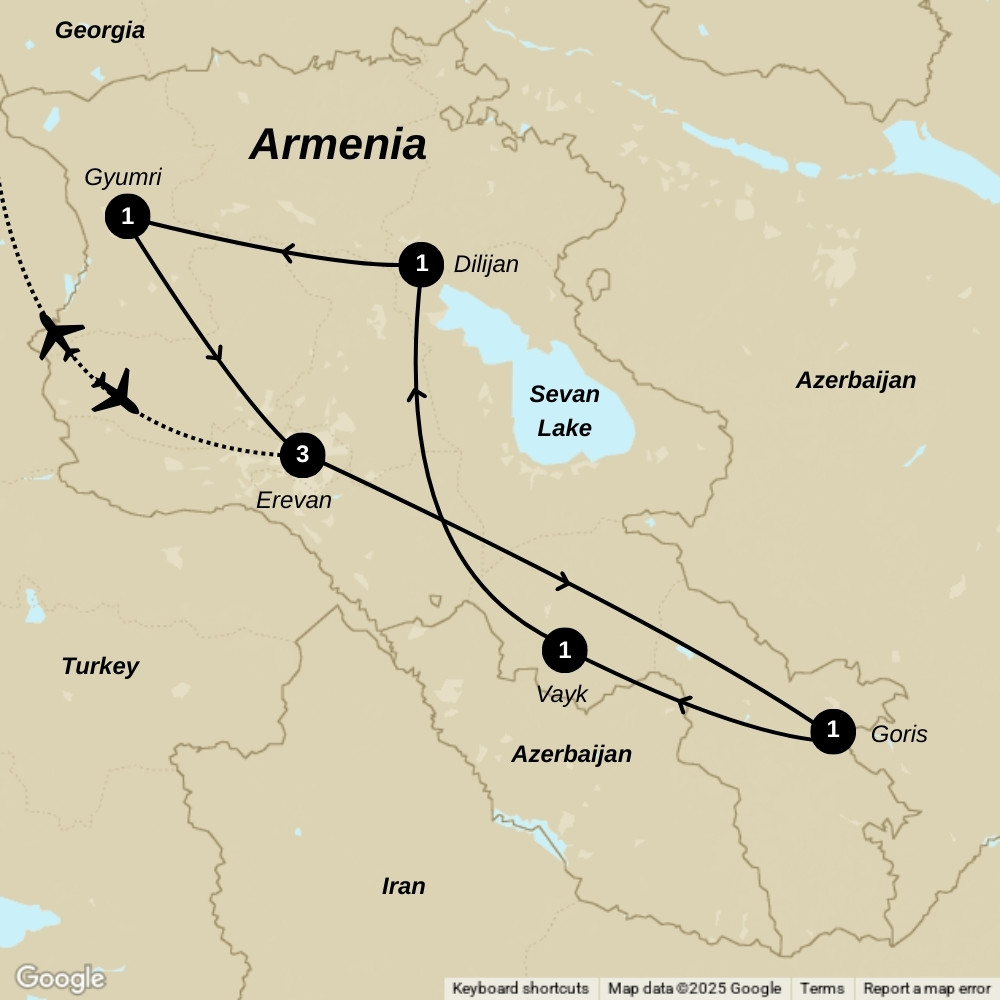




-
Day 1
Yerevan
Arrival at Zvartnots International Airport. After proceeding through customs and collecting your luggage you will be met by your driver and taken to the hotel (transfer excluded). Check in from 14:00. Overnight in the Yerevan hotel.
Tour options & excursions available
Airport – Hotel Transfer (Without Guide)
Hotel: Ani Central Inn | Cascade (or similar)
Hotel (4): Ani Plaza | Hayasa | Median (or similar) -
Day 2
Yerevan
Depart for the Yerevan full day city tour that includes all the major sights of the capital. Yerevan is on the list as one of the world’s “Oldest continuously inhabited cities“, dating back to 8th century BC. It's very lively with open cafes, eateries and local markets. Enjoy a panoramic view of Opera House, the magnificent scenery of the two ice-capped biblical Mount Ararat, Swan Lake, Northern Avenue and Republic Square which is considered one of the most amazing and famous place of the capital.
Visit “Matenadaran” a home to the world’s largest collection of Armenian Illuminated manuscripts. In the funds of the Matenadaran there are preserved thousands of ancient manuscripts vintage archival documents. Here you will have a chance to see the biggest book weighing 28 kilograms, and the smallest one weighing only 19 grams.
Head to the Genocide museum which displays unprecedented international documents on Armenian Genocide, carried out by Ottoman Turkey in 1915. After the museum tour, we will explore the memorial complex of Tsitsernakaberd dedicated to 1.5 million victims of Armenian Genocide.
Evening at leisure. You can have an evening walk through Northern Avenue towards the Republic Square, where you will admire the Dancing Fountains (start from 9 pm). Overnight in Yerevan.
Hotel: Ani Central Inn | Cascade (or similar)
Hotel (4): Ani Plaza | Hayasa | Median (or similar) -
Day 3
Yerevan - Khor Virap - Areni - Noravank - Yerevan
Depart to Khor Virap Monastery (“deep pit”), at the base of Mount Ararat. The monastery location gives the opportunity to enjoy a beautiful view to biblical Ararat Mountain, where Noah’s arch cast an anchor.
*Please note that the visibility may be difficult depending on weather conditions.
Head to Areni, which is best known for its wine production and with assortment of unmatched wine. Here you will have the chance to enjoy degustation of local wines produced from endemic variety of grapes called Areni.
Depart to Noravank Monastery, an architectural gemstone nestled among brick-red cliffs, just above a deep gorge. Built in the 13th century, the monastery is a lovely example of the ornate architecture of the period.
Drive back to Yerevan and overnight.
Hotel: Ani Central Inn | Cascade (or similar)
Hotel (4): Ani Plaza | Hayasa | Median (or similar) -
Day 4
Yerevan
Head to Etchmiadzin city, the center of Armenian Christianity, which is considered to be the "Vatican" city of Armenia with the Holy See of the Armenian Apostolic Church. Stop near the 7th century Zvartnots Cathedral (UNESCO World Heritage). Continue to the Catherdral of Etchmiadzin/301-303 AD (UNESCO World Heritage), the first church of Armenia.
NOTE: In the Etchmiadzin Cathedral there have been cosmetic reconstruction processes lately and a new layer of frescos was discovered and by the announcement of the government the cathedral is blocked, as they are doing researches and new excavations too. This means that the guests might not see the inside of the church.
On your way to Yerevan visit Saint Hripsime Church (UNESCO World Heritage), one of the oldest surviving churches in Armenia.
Visit ‘Gumi Shuka’’, an Armenian indoor market, where you can have especially handpicked selection of local homemade products: dried fruit, pickles, spices…
Evening at leisure.
Overnight in Yerevan.
Hotel: Ani Central Inn | Cascade (or similar)
Hotel (4): Ani Plaza | Hayasa | Median (or similar) -
Day 5
Yerevan
Depart to Garni village, famous for its Hellenistic pagan temple of the first century, the only pagan temple that survived after the Christianization of Armenia.
Lunch at a local restaurant/ house. Experience lavash baking (Armenian traditional bread; UNESCO Cultural Heritage) demonstration. Get familiar with the technique of the preparation. After that enjoy “brduj” (stuffed bread roll) and taste the freshly baked bread stuffed with young cheese and local herbs.
Descend the Azat River Gorge, where the “Symphony of Stones” or “Basalt Organ” seats. Those basalt columns were formed millions of years ago as a result of slow-moving lava.
Drive to Geghard Monastery (UNESCO World Heritage) - a monastery which is hewn out from a cave. Not only the rock sculpted structures are fantastically spiritual, the cliffs surrounding it are shrouded with mystery. Right at the entrance local women sell candies, dried fruit, sweet sujukh, Geghard gata. Driving back to Yerevan. Evening at leisure. Overnight in Yerevan.
Hotel: Ani Central Inn | Cascade (or similar)
Hotel (4): Ani Plaza | Hayasa | Median (or similar) -
Day 6
Yerevan - Dilijan - Yerevan
Scenic drive along the pearl of Armenia, Lake Sevan.. Your next stop is the 9th century monastery complex on Sevan peninsula named Sevanavank. The peninsula can be named the very point from where the whole beauty of the Lake Sevan is seen.
Head to Dilijan to enjoy its natural and architectural monuments of antiquity, the mountains and the forests that surround you at any point in the city. In the "Old Town" you will see unique balconies and terraces typical of 19th century Dilijan that display the region’s historical love for fine woodwork. Visit Haghartsin Monastery (13th c. A.D) hidden among dense oak woods. Drive back to Yerevan. Overnight at the hotel in Yerevan.
Hotel: Ani Central Inn | Cascade (or similar)
Hotel (4): Ani Plaza | Hayasa | Median (or similar) - Day 7 Return Transfer to the airport and departure (transfer excluded).
Included
Transportation with a Car; Minivan; Minibus or Bus according to group size during the excursion days
Hotel accommodation in the selected category; incl. Breakfast
Guide: English Speaking Guide
Entrance fees; Matenadaran; Garni temple; Zvartnots Temple; Symphony of Stones
1 x Wine Tasting 1 x Lunch at a local house/ restaurant
Lavash baking master class
1x bottle (0.5 ml) of water per day per guest
Exclusions
Insurances;
Flights
Airport-hotel-airport transfer without guide
Lunches and Dinners
Personal expenses (phone calls; beverages; …)
Child seats (on request basis only)
Tips for drivers and tour guide If the service is good we recommend to tip: Guide: starting from 3-4 EUR/USD per person per day Driver: starting from 2-3 EUR/USD per person per day
Porters in the hotels and at the airport
Traveling to Armenia
General Overview
Located at the crossroads of Europe and Asia, Armenia has for millennia occupied a major historical, cultural and religious crossroads. An ancient land with deep roots, it is today a dynamic country in constant evolution, where millennia-old heritage blends seamlessly with a confident modern identity. Traveling to Armenia means discovering a still relatively undiscovered destination, where history is etched into monastery stones, mountainous landscapes and living traditions.
Yerevan, the capital, charms visitors with its warm atmosphere and relaxed pace of life. Built largely from pink volcanic tuff stone, the city offers understated elegance and an unexpectedly high quality of life. The country covers an area of 29,743 km². Armenian is the official language and the local currency is the Armenian dram. Armenia operates on 230V electricity. The time difference is eight hours ahead of Montreal, and the international dialing code is 374.
Did You Know…
Armenia is considered one of the cradles of winemaking civilization. In 2011, archaeologists uncovered the world’s oldest known winery in the village of Areni, evidence of a wine tradition dating back over 6,000 years. The country is also renowned for its excellence in chess, a discipline taught in schools from a very young age.
The Armenian diaspora is one of the largest in the world, with more Armenians living abroad than within the country itself, largely as a result of the Armenian Genocide and subsequent migration waves. Armenia also holds an impressive record with the “Wings of Tatev” cable car, the longest non-stop cable car in the world, connecting the village of Halidzor to the Tatev Monastery. Finally, five Armenian sites are listed as UNESCO World Heritage Sites, reflecting the country’s rich cultural and spiritual legacy.
Sevan National Park
Established as a national park in 1978, Sevan is one of Armenia’s natural jewels. Lake Sevan, a vast freshwater lake of tectonic origin, is often referred to as the country’s “inland sea.” Surrounded by mountains and forests, it supports a rich biodiversity in its waters, along its shores and in the nearby Masrik River. Despite the fragility of its ecosystem, the park is a popular leisure destination for Armenian families. Hiking, water activities and moments of quiet contemplation unfold in a peaceful and majestic setting.
Mount Aragats and Khor Virap Monastery
Towering over the landscape, Mount Aragats is Armenia’s highest peak and the tallest in the South Caucasus, reaching 4,095 meters. This ancient volcano holds a sacred place in the Armenian imagination, steeped in legends and ancestral tales. At its foot stands Khor Virap Monastery, one of the country’s most iconic landmarks. Its ochre silhouette contrasts beautifully with the snow-capped peaks behind it. A major spiritual site, Khor Virap is also deeply historical: it is here that Saint Gregory the Illuminator was imprisoned before converting Armenia into the world’s first Christian state. For hiking enthusiasts, the ascent of Mount Aragats offers a reward equal to the effort, with spectacular high-altitude landscapes dotted with alpine lakes.
Debed Canyon and Alaverdi
The Debed Canyon and the Alaverdi region reveal a dramatic landscape shaped by a river carving deep gorges through the mountains. A humid climate has fostered lush vegetation, enhanced by springtime blooms. The winding road through the canyon is an experience in itself, unveiling picturesque villages and vertiginous views at every turn. The UNESCO-listed monasteries of Haghpat and Sanahin embody the brilliance of Armenian religious architecture and lend the region a powerful spiritual presence. From the heights, views over the canyon and the Alaverdi Valley leave a lasting impression.
Dilijan National Park
Often referred to as the “Little Switzerland of Armenia,” Dilijan National Park is a green haven in the northeast of the country. Renowned for its mineral springs and rich flora and fauna, it is also home to some of Armenia’s most beautiful monasteries, including Haghartsin and Goshavank. Hiking trails wind through forests, lakes and meadows, offering a succession of soothing panoramas. The town of Dilijan, with its stone houses and wooden balconies, provides a charming stop imbued with mountain authenticity.
Lake Kari
Perched at an altitude of 3,190 meters, Lake Kari is a striking natural site. This high-altitude crater lake, located in the shadow of Mount Aragats, captivates visitors with the purity of its deep blue waters and its almost surreal atmosphere. In summer, it offers a refreshing escape from the heat of the plains, while in winter, its snow-covered surroundings create an atmosphere of near-mystical silence.
Lake Arpi National Park
Situated at over 2,000 meters above sea level, Lake Arpi National Park is a paradise for lovers of wide-open spaces. Surrounded by wetlands and alpine landscapes, it is ideal for hiking, wildlife observation and horseback riding. In spring, wildflowers blanket the meadows, making this season the ideal time to visit. Although swimming is prohibited, the site’s natural richness more than compensates.
Geghard Monastery
Geghard Monastery is undoubtedly one of Armenia’s most impressive monuments. Partially carved directly into the rock, it blends harmoniously into the surrounding mountain landscape. Listed as a UNESCO World Heritage Site, this exceptional complex is as striking for its architecture as for the atmosphere of reflection that prevails within its walls. The lush and dramatic natural setting completes this unique tableau.
Tatev Monastery
Tatev Monastery is often one of the highlights of a journey through Armenia. Accessible via the “Wings of Tatev” cable car, it overlooks spectacular gorges. Rich in history, the site features remarkable frescoes and bears witness to its former importance as a religious and educational center. Nearby, the gorges and the Devil’s Bridge, a natural formation of warm water pools, add a fascinating geological dimension to the visit.
Yeghegis Valley
Still little known to travelers, the Yeghegis Valley is a concentrated blend of nature, history and legend. Ancient churches, discreet monasteries and tranquil landscapes unfold throughout the region. The medieval fortress of Smbataberd, perched on the heights, offers breathtaking views. After a hike, it is not uncommon to be welcomed by locals with a slice of homemade gata, a symbol of Armenian hospitality.
Noravank Gorge and Monastery
Framed by dramatic red-hued cliffs, Noravank Monastery is one of Armenia’s most photogenic sites. This masterpiece of medieval Armenian architecture houses the tombs of great artists and intellectuals. The contrast between the pale stone of the monastery and the fiery cliffs creates a striking visual harmony.
Garni Gorge
While the pagan Temple of Garni naturally draws attention, the surrounding area is equally remarkable. Garni Gorge offers a unique natural spectacle, notably the famous Symphony of Stones. These basalt columns, formed by solidified lava, resemble a mineral waterfall and are accessible via an easy, well-maintained trail.
Khndzoresk
The troglodyte village of Khndzoresk bears witness to a way of life that has now disappeared. Until the 20th century, families lived in cave dwellings carved into the mountainside and connected by underground tunnels. Visitors access the site by crossing an impressive 160-meter suspension bridge, adding an adventurous touch to this extraordinary discovery.
Arevik National Park
Remote and unspoiled, Arevik National Park is an ideal destination for travelers seeking wilderness. Butterflies, birds, wild cats and waterfalls share this little-known territory. The ruins of an old mosque, hidden within a lush natural amphitheater, recall the region’s rich multicultural past. Here, silence and contemplation reign supreme.
Cuisine
Armenian cuisine is deeply rooted in tradition and emotion. Far more than lavash or khorovats, it is defined by recipes passed down through generations, prepared with patience and generosity. In Yerevan restaurants as well as village homes, dishes tell stories and reflect the soul of the country.
Typical Dishes
Among the must-try dishes, harissa holds a special place. Made from wheat and chicken, it is both nourishing and symbolic. Zhingyalov hats, a specialty from Artsakh, highlights wild herbs depending on the season. Gata, a traditional pastry, varies from region to region and often accompanies festive occasions.
Ghapama, a pumpkin stuffed with rice and dried fruits, is as beautiful as it is flavorful and symbolizes abundance. Dolma, vine or cabbage leaves filled with meat, is one of the most internationally recognized Armenian dishes. More adventurous specialties such as qyala from Gyumri or khash, a winter soup traditionally shared during convivial gatherings, are integral to Armenian culinary identity.
Beverages
Armenia is world-renowned for its cognac, a true national pride. This exceptional brandy often accompanies meals and celebrations, extending the country’s ancient winemaking tradition.
Shopping and Souvenirs from Armenia
Wine and brandy are among the most popular souvenirs. Armenian carpets and kilims, with their intricate patterns and symbolic designs, are highly sought after. Decorative objects featuring pomegranates or Mount Ararat immediately evoke national identity. Khachkars, intricately carved cross-stones, reflect a unique medieval art form and make deeply cultural keepsakes.
Safety
Armenia is considered a safe country. Standard precautions are sufficient, although sensitive border areas should be avoided. The Canadian Embassy is located in Yerevan.
Health Advice
As with any trip, travelers are advised to exercise caution with food and water and to consult a travel health clinic before departure to verify required vaccinations. A simple rule applies: consume only what is boiled, cooked or peeled.
Climate
Armenia has a continental climate, with hot, dry summers and cold winters, particularly at higher altitudes. Spring and autumn generally offer the most pleasant travel conditions, combining mild temperatures with colorful landscapes.
Religions and Beliefs
Armenia was the first country in the world to officially adopt Christianity, in the year 301. The vast majority of the population belongs to the Armenian Apostolic Church. Smaller religious minorities reflect a cultural diversity present for centuries.
Etiquette and Customs
Tipping is at the traveler’s discretion but is appreciated when service has been satisfactory. Respectful attire is required in churches, where certain behavioral norms are observed, particularly near the altar. Armenian hospitality is legendary, and a journey through the country is often marked by the warmth and generosity of its people.
Name: Best of Armenia
Brand: Pathways of the World
Quality: First Class
Tour Type: Escorted
Start City: Yerevan
End City: Yerevan
Vacation Overview:
Armenia, with its cultural and historical heritage, its diverse landscapes, climate, wildlife, flora, its unique cuisine, and especially its welcoming population, offers opportunities for cultural travel based on the discovery of the country’s culture, history, and nature, its people, and their way of life.