



Call to speak with one of our Tour Experts 1-877-230-8747
-
 Victoria Guestx7121
Offline
Victoria Guestx7121
Offline
-
 Beth Mckinley
Offline
Beth Mckinley
Offline
-
 Monique Kwirant
Offline
Monique Kwirant
Offline
-
 Kaylee Toth
Offline
Kaylee Toth
Offline

-
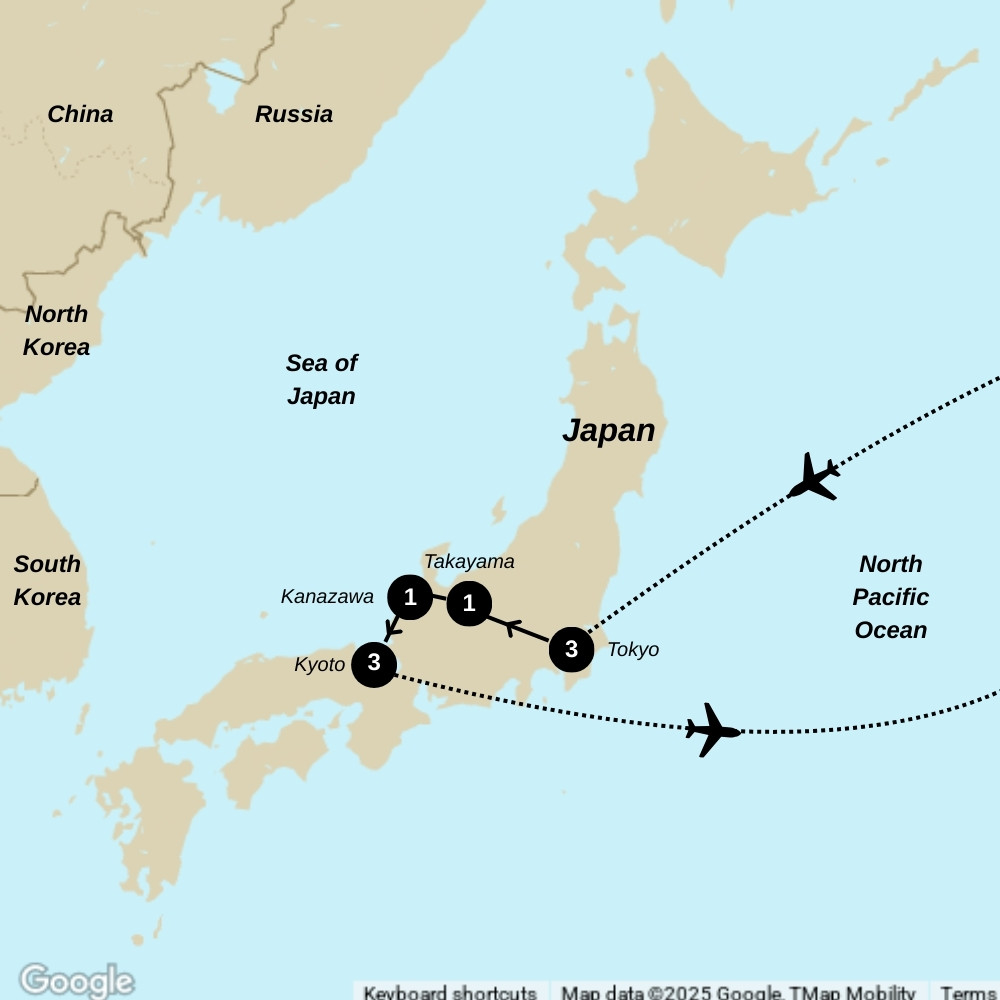
Day 1
Arrival in Japan
You will arrive either at Haneda or Narita. Upon arrival, please receive your
luggage at the baggage claim. After the baggage claim, you’ll be transferred to
your hotel in Tokyo City by a private reserved taxi with a Japanese driver.
Check-in at your hotel room on your own(Available from 15:00~). Balance of the
day at leisure to adjust time difference and jet lag.
The service for today will end after arrival at the hotel. -
Day 2
Tokyo
Start a day of the tour that includes visits to several key locations in Tokyo. First,
you will visit Senso-ji temple, the largest Buddhist temple in Tokyo, where you will
learn about its history and legends, and experience how to purify yourself, pray,
and draw an Omikuji. Next, we will visit the Imperial Palace's outer garden, walk
along the moat and outer enclosure, and learn about the history of Edo Castle and
the Imperial Palace. Then, at Meiji-jingu Shrine, you will discover how to wash
your hands in the Temizuya, say a Shinto prayer, write a wish on an Ema tablet,
and draw a special Omikuji. We will also visit Takeshita Street, known for new
Japanese fashion trends and street food, and Shibuya, the largest entertainment
and shopping district, where you will learn about Hachi the loyal dog and
photograph the famous Shibuya scramble crossing.
Special experience: (either today or Day 7 at Kyoto)
Japanese Tradition Tea Ceremony with Kimono Experience. -
Day 3
Tokyo
Free day in Tokyo
Today is free time at leisure to enjoy and explore Tokyo at your own pace.
Optional tours are available upon request. Please inquire. -
Day 4
Tokyo - Mount Fuji - Takayama
A day depart for your journey to the majestic Mt. Fuji includes visiting Mt. Fuji 5th
Station. At the Mt. Fuji 5th Station, you’ll have some time to admire the
breathtaking views of Mt. Fuji.
After the Mt. Fuji 5th Station, you will visit Highland Resort Hotel & Spa.
You will have some free time to enjoy lunch on your own at the Highland Resort
Hotel & Spa. Then, continue your journey and head toward the historic town of
Takayama. Enjoy the scenic views during the ride. -
Day 5
Takayama - Shirakawago - Kanazawa
For early risers, explore yourself at the Takayama Morning Market, a lively and
colorful market where you can find fresh produce, handmade crafts, and local
delicacies.
Walking through Sanmachi Suji is like stepping back in time to Japan’s Edo period.
This well-preserved district features narrow streets lined with wooden merchant
houses, sake breweries, and traditional shops.
Then, continue your journey from Takayama to Kanazawa, with a sightseeing stop
at Shirakawago along the way, a beautiful UNESCO World Heritage village famous
for its traditional Gassho-zukuri houses.
The Wada House, an Important Cultural Property of Japan, is the largest traditional
gassho-style farmhouse in Shirakawa-go. Constructed in the late Edo period
(1603–1867), it showcases the wealth and status of the Wada family, who for
centuries were the largest landowners and held the hereditary position of village
headman (nanushi) in Ogimachi village.
After your visit to Shirakawago, we will head to Kanazawa, arriving at Kanazawa
for your overnight stay. -
Day 6
Kanazawa - Kyoto
This morning is free at leisure to explore the city at your own pace.
Don’t miss the Kenrokuen Garden, one of the Three Great Gardens of Japan and
is considered one of the most beautiful gardens in the country. It is located in the
center of Kanazawa and is known for its beautiful landscapes, ponds, and
teahouses. The Kanazawa Castle, a historic castle built in the 16th century and
served as the seat of the Maeda clan, who ruled Kanazawa for over 250 years.
The castle is now a museum and is open to the public. Lastly, enjoy an early lunch
at Omicho Market, a lively market known for its fresh seafood, produce, and other
goods. The market is a great place to experience the local culture and cuisine.
This afternoon, depart Kanazawa for Kyoto. -
Day 7
Kyoto
Kyoto Day tour with English-speaking guide in public transportation (6
hours)
Visit the World Heritage Site Kinkaku-ji. Discover the iconic symbol of Kitayama
culture, Kinkaku-ji. This stunning three-story pavilion overlooks Kyokochi Pond and
showcases the architectural elegance of the Muromachi period, with its upper two
stories adorned in gold leaf. The surrounding garden, designated a Special Historic
Site and a Special Place of Scenic Beauty, adds to the serene experience.
Stroll freely through Arashiyama, one of Kyoto’s most famous destinations. Admire
the breathtaking scenery that transforms beautifully with each season, offering a
tranquil and memorable experience.
Visit the Famous Senbon Torii at Fushimi Inari Taisha. Experience the
mesmerizing tunnel of crimson torii gates at Fushimi Inari Taisha, one of Japan’s
most beloved landmarks. This stunning sight is perfect for capturing unforgettable
memories and enjoying the spiritual atmosphere. -
Day 8
Kyoto
Free day in Kyoto
Today is free time at leisure to enjoy and explore Kyoto at your own pace.
Option:
For the travelling period of Apr 13-Oct 13, 2025, you have a chance to visit Osaka
Expo.
2025 Osaka Kansai Expo Admission Ticket
One-day ticket at CAD$ 75 per person.
Other optional tours are available upon request. Please inquire. -
Day 9
Return
Today, take your time to explore more about Kyoto until time to be transferred by
your private reserved taxi to either Kansai or Itami Airport.
The service will end upon arrival at the airport.
END OF SERVICE
- Accommodation in specified hotels or similar
- Daily breakfast
- Airport transfers by Private reserved Taxi (Japanese driver only) from Haneda/Narita Airport to the hotel on Day 1
- Tokyo tour with English speaking guide in public transportation (6 hours) on Day 2 including 1 day Tokyo Metro Pass
- Sightseeing as per itinerary
- Coach services from Day 4 to Day 6
- Kyoto tour with English speaking guide in public transportation (6 hours) on Day 7 including 1 day Kyoto Metro Pass
- Departure Airport transfer by Private reserved Taxi (Japanese Driver only) from the hotel to Kansai or Itami Airport on Day 9
- Hands on Experience
Exclusions
- International airfares, taxes, and fuel surcharges
- Optional tours and experiences, all admissions
- Shipping, handling, and excess baggage charges
- Gratuities to driver, guide, porter, and restaurant staff
- Travel insurance and insurance of all kinds
- Public transport costs, taxi fares, etc.
- Other meals not included in this itinerary
- Personal expenses such as drinks,mini-bar, laundry
- Anything not mentioned in the inclusions.
Traveling to Japan
General Overview
Japan, known as the Land of the Rising Sun, is an island nation located in the Pacific Ocean, made up of more than 6,800 islands. Four main islands dominate the archipelago—Hokkaido, Honshu, Shikoku and Kyushu—which together account for 97% of the country’s total land area. With a population exceeding 126 million inhabitants, Japan combines ancient traditions with cutting-edge modernity in a way found nowhere else in the world.
Tokyo, the capital, is a vast metropolitan area composed of 23 districts rather than a single city, offering an endless array of experiences. Japan covers an area of 377,973 km². Japanese is the official language, and the national currency is the yen (JPY). The country operates on a voltage of 100V, and travelers will need a power adaptor. Japan is 15 hours ahead of Montreal, and its international dialing code is 81.
Did You Know…
Tokyo is often thought of as the largest city in Japan, yet the most populous city is actually Yokohama. Tokyo itself has not officially been a city since 1943, but rather a metropolitan prefecture made up of multiple districts, making it a capital without being a city in the traditional sense.
Japan is also home to some of the world’s most unusual villages. In Nagoro, for example, life-size dolls now outnumber human residents. Created by a local artist to represent former villagers who have passed away or moved elsewhere, these figures have earned Nagoro the nickname “the village of dolls.”
On March 11, 2011, a powerful earthquake measuring 8.9 on the Richter scale struck Japan. Its force was so immense that it shifted the country by approximately 2.4 meters and altered the Earth’s axis by nearly 10 centimeters.
Geishas are often misunderstood in Western culture. Far from being entertainers of ill repute, they are highly respected artists trained for up to seven years in traditional arts such as music, dance, poetry, kimono wearing and the tea ceremony. They enjoy significant social prestige and represent an important cultural heritage.
Tokyo
A symbol of ultra-modernity and innovation, Tokyo fascinates with its contrasts. Neon-lit districts such as Shibuya and Akihabara coexist with peaceful neighborhoods, historic temples and vast green spaces. Beyond the city’s frenetic energy lies a quieter Tokyo, revealed through strolls in traditional residential areas or moments of calm in its many parks.
Kanazawa
Less crowded than many major destinations, Kanazawa boasts a rich historical heritage. Visitors can explore the Ninja-dera Temple, Kanazawa Castle and well-preserved geisha and samurai districts. Its coastal location along the Sea of Japan further enhances its appeal.
Shirakawago
Shirakawago offers a glimpse into rural Japan through its traditional gassho-zukuri farmhouses, characterized by steep thatched roofs designed to withstand heavy snowfall. Walking among these dwellings feels like stepping into a living postcard, far removed from Japan’s urban centers.
Nikko
Located about 150 kilometers north of Tokyo, Nikko is ideal for travelers seeking a balance of culture and nature. Its UNESCO-listed shrines and temples are nestled within forests of ancient cedar trees. Nearby Yumoto Onsen provides the perfect opportunity to relax in natural hot springs after a day of exploration.
Osaka
Japan’s third-largest city and a major hub in the Kansai region, Osaka is vibrant, friendly and full of character. Highlights include Osaka Castle and the Sumiyoshi Taisha Shinto Shrine. Neighborhoods such as Namba, Shinsekai and Dotonbori pulse with life, street food and neon lights, while Kuromon Ichiba Market offers an authentic culinary experience.
Hokkaido
For those seeking a wilder side of Japan, Hokkaido delivers. Located in the north, this island is known for its pristine forests, volcanoes, hot springs and wide-open landscapes. In winter, snow transforms the scenery into a breathtaking wonderland, ideal for nature lovers and outdoor enthusiasts.
Hiroshima
Hiroshima stands as a powerful symbol of resilience and peace. Rebuilt after the devastation of World War II, the city conveys a moving message through its Peace Memorial Park and Atomic Bomb Dome. When cherry blossoms bloom, the contrast between beauty and memory becomes even more poignant.
Shikoku Island
The smallest of Japan’s four main islands, Shikoku remains largely untouched by mass tourism. A paradise for nature lovers, it features beautiful beaches, rich marine life and excellent surfing spots. Shikoku is also famous for the 88-Temple Pilgrimage, a spiritual route connecting sacred sites across the island.
Kyoto
As Japan’s former imperial capital, Kyoto is the heart of traditional culture. With its countless temples, shrines and palaces—including the Golden Pavilion, Fushimi Inari Shrine and Nijo Castle—the city offers endless discoveries. Wander through the bamboo forest of Arashiyama or the historic streets of Gion to fully absorb its atmosphere. Surrounded by hills, Kyoto also provides excellent hiking opportunities, especially stunning during the autumn foliage season.
Nara
Nara combines cultural heritage with natural serenity. Home to the Great Buddha of Todai-ji Temple, the city is also famous for its free-roaming deer, which wander through Nara Park and often approach visitors with curiosity.
Kirishima–Yakushima National Park
Located on the island of Kyushu, this national park offers volcanic landscapes, ancient cedar forests, hot springs and panoramic hiking trails. It is an ideal destination for those seeking an off-the-beaten-path experience immersed in nature.
Ogasawara Archipelago
Often referred to as the “Japanese Galapagos,” the Ogasawara Islands are a remote tropical paradise. With turquoise waters, lush vegetation and vibrant marine life, the archipelago offers unforgettable experiences such as snorkeling, hiking and swimming among colorful fish.
Matsumoto
Matsumoto Castle, known as the “Crow Castle” for its black exterior, is one of Japan’s most beautiful and best-preserved feudal castles. The surrounding region, dotted with rice fields and mountain scenery, invites travelers to slow down and explore rural Japan.
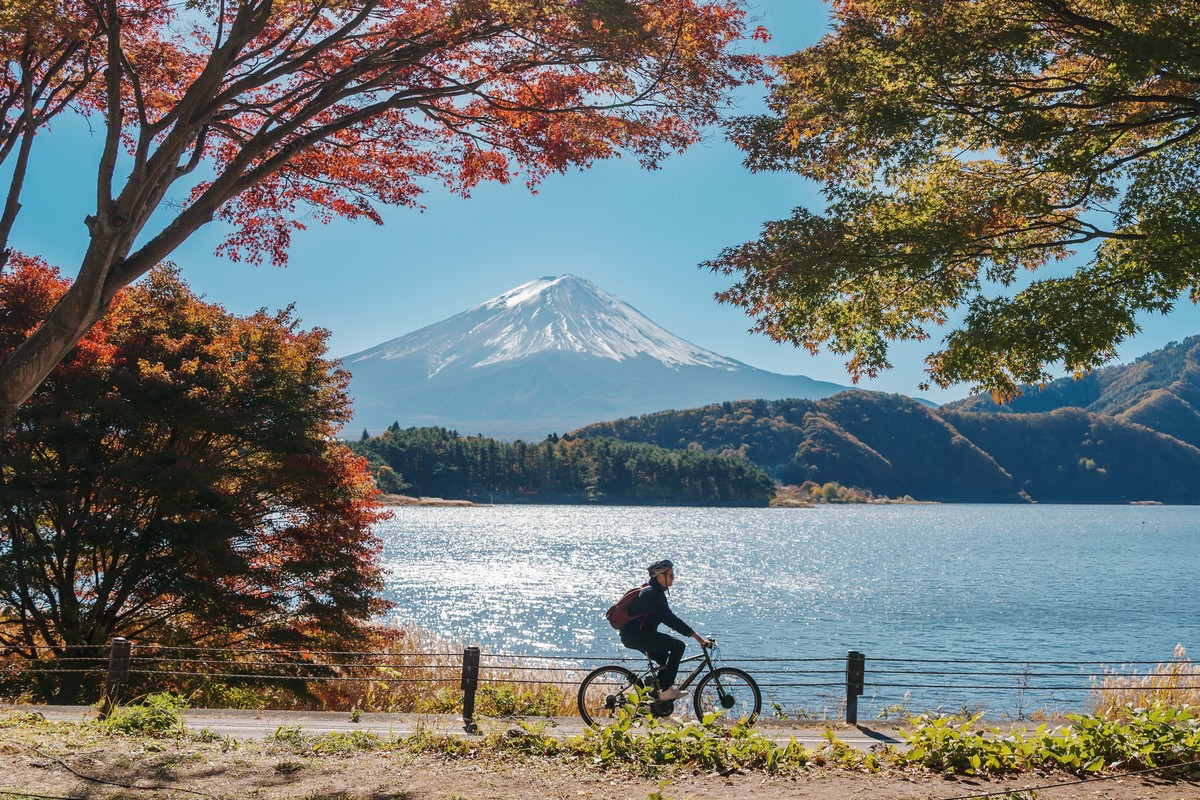
Mount Fuji
Japan’s most iconic natural landmark, Mount Fuji is sacred, majestic and instantly recognizable. It can be admired from Lake Kawaguchi or explored from Hakone, which offers a wider range of activities. Adventurous travelers may choose to climb the mountain during the official hiking season.
Nagoya
More peaceful than Tokyo or Osaka, Nagoya rewards travelers willing to linger. From the futuristic Oasis 21 to the Hommaru Palace, green Buddha statues and elegant gardens, the city blends modern architecture with traditional charm.
Kamakura
Located just 50 kilometers south of Tokyo, Kamakura is a relaxing coastal retreat. Nestled between the ocean and wooded hills, it is known for its temples, shrines and serene atmosphere.
Ine-Cho
This small fishing village, situated between mountains and sea near Kyoto, is famous for its funaya—traditional wooden houses built on stilts along the waterfront. Ine-Cho offers a peaceful and authentic glimpse into rural coastal life.
Himeji
Himeji is home to Japan’s most spectacular feudal castle. Known as the “White Heron Castle” due to its brilliant white walls, it is remarkably well preserved. Its maze-like corridors and defensive design transport visitors straight into medieval Japan.
Cuisine
Japanese cuisine is celebrated worldwide for its balance, freshness and refinement. Based on rice, noodles, fish, vegetables and seaweed, it emphasizes seasonal ingredients and subtle flavors. Over time, it has also incorporated Western influences while maintaining its strong cultural identity.
Typical Dishes
Japanese specialties include sushi in its many forms, ramen and other noodles, miso soup, tempura, onigiri rice balls, donburi rice bowls, yakitori skewers, yakiniku grilled meats, okonomiyaki pancakes, sukiyaki hot pot, gyoza dumplings and Western-inspired dishes such as omurice. Desserts like mochi and taiyaki add a sweet conclusion to meals.
Drinks
Tea is central to Japanese culture, with varieties such as sencha, matcha, genmaicha and mugicha consumed daily. Other popular beverages include ramune soda, aloe vera drinks, amazake and bubble tea. Each reflects Japan’s ability to blend tradition with modern tastes.
Shopping and Souvenirs from Japan
Popular souvenirs include Japanese sweets, green tea, sake, bento boxes, chopsticks, lucky charms, origami paper and traditional crafts. Seasonal Kit Kat flavors are particularly famous, making for fun and unique gifts.
Safety
Japan is widely regarded as one of the safest countries in the world. Crime rates are extremely low, and daily life is highly organized. Natural disasters, particularly earthquakes, represent the primary risk. The Canadian Embassy is located in Tokyo.
Health
According to the World Health Organization, Japan’s healthcare system ranks among the best globally. Travelers are advised to consult a travel health clinic prior to departure to ensure vaccinations are up to date.
Climate
Japan’s climate varies greatly due to its north-south length of nearly 3,000 kilometers. The north experiences colder, temperate conditions, while the south enjoys a humid subtropical climate. Each season offers a distinct and beautiful travel experience.
Religions and Beliefs
Shintoism, Japan’s indigenous religion, centers on nature worship and deeply influences daily life. Buddhism, introduced in the 6th century, coexists harmoniously with Shinto practices. Christianity exists as a small minority. Japanese spirituality is often pragmatic and syncretic, with religions practiced according to their perceived benefits.
Etiquette and Customs
Politeness, modesty and respect are fundamental in Japan. Greetings are made with a bow, public behavior is discreet, and punctuality is highly valued. Silence in elevators, orderly conduct on public transportation and respect for personal space are important cultural norms. Gift-giving follows specific etiquette, and business cards are exchanged with both hands.
Name: Essentials of Japan
Brand: Pathways of the World
Quality: First Class
Tour Type: Escorted
Start City: Tokyo
End City: Kyoto
Vacation Overview:
Traveling to Japan is a captivating blend of tradition and innovation. From the neon-lit streets of Tokyo to the tranquil temples of Kyoto, Japan offers a journey through time and culture. Visitors can enjoy world-famous cuisine like sushi and ramen, experience the beauty of cherry blossoms in spring, or soak in a peaceful onsen (hot spring). Explore ancient castles, cutting-edge technology, and stunning natural scenery—from Mount Fuji to serene bamboo forests. With its unique harmony of the old and the new, Japan promises an unforgettable travel experience.