



Call to speak with one of our Tour Experts 1-877-230-8747
-
 Victoria Guestx7121
Offline
Victoria Guestx7121
Offline
-
 Alex Williams
Offline
Alex Williams
Offline
-
Day 1
Arrival in Lima
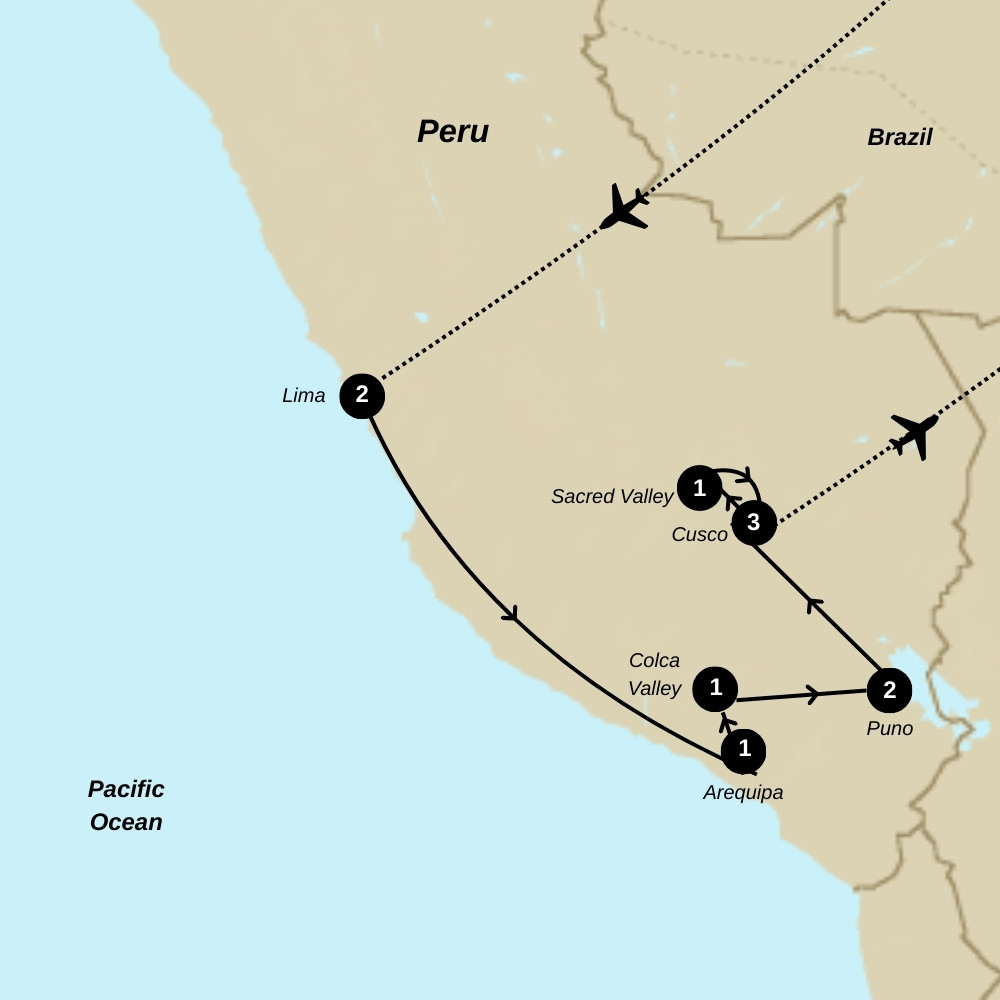
Arrive at Jorge Chavez International Airport in Lima. Upon arrival, a representative will be waiting to greet you at the airport and the transportation service will transfer you to your hotel at the scheduled time. Spend the rest of the day at your leisure in Lima, the capital of Peru and a city steeped in history. During Colonial times, the Historic Centre of Lima, known as the “Ciudad de Los Reyes” (City of Kings), was the political, administrative, religious and economic centre for the Spanish in Peru. The historical centre is a UNESCO-listed World Heritage Site. Lima is now a modern metropolis and is currently undergoing an exciting process of cultural and economic change. Take the opportunity to rest and recover after the flight or head out into the city for your first glimpse of life in Peru´s sprawling capital city. Alternatively, you can book our optional Magic Water Circuit with Dinner: Magic Water Circuit with Dinner (shared basis):A modern system of fountains certified as the largest in the world by the Guinness World Records. Built-in Exhibition Park, the Magical Water Circuit attracts crowds during summer and winter, being one of the new favorite attractions of Lima. See yourself and enjoy our water cruise that is followed by a unique gastronomical experience at a restaurant, accompanied by a delicious dinner.Notes: Shared service. Not available on Sundays and Mondays. Start time: 17:30 hours. Duration 4 hours. Includes Pick-up and Drop-off, Bilingual guide (Spanish and English), Admission to Magic Water Circuit, and Dinner Overnight in Lima
Hotel: Tierra Viva Lima 3* (or similar) -
Day 2
Lima
Wake up to breakfast in the hotel before hitting the streets of Lima’s old town, a UNESCO-listed World Heritage Site packed with fascinating historical buildings. Start with the Larco Museum, located in the traditional Pueblo Libre district, which is housed in a beautifully restored viceregal mansion built on a pre-Columbian pyramid. The museum boasts the world’s most complete pre-Hispanic collection of gold and silver objects, as well as pieces of erotic art. Then visit Casa Aliaga, a colonial mansion granted in 1535 by chief conquistador Francisco Pizarro to Jerónimo de Aliaga, one of his captains. This is the only house from that time that to this day has always been owned by the same family. Continue to a scenic tour in the colonial downtown, which originates and spreads out from the Main Square. Here you can appreciate the grandiose architecture of the Spanish Empire and be amazed by Lima´s Cathedral. Erected in the 16th century, this building took more than 80 years to complete. After the tour, you’ll be transferred back to the hotel. Rest of the afternoon at leisure. Overnight in Lima.
Hotel: Tierra Viva Lima 3* (or similar) -
Day 3
Lima - Arequipa
Breakfast at the hotel is followed by a transfer to Lima airport. Once you land in Arequipa, a transportation service will take you to your hotel. Then, after a representative informs you about the attractions and services the city has to offer, go enjoy a tour of the town. The route begins in Arequipa´s Main Square, one of the most beautiful squares in Peru. Facing this square is the imposing Cathedral, built in the 17th century. From there, continue to the Monastery of Santa Catalina, a cloister and small religious citadel built in 1579, still in use to this date. Lastly, visit the districts of Yanahuara and Carmen Alto for a panoramic view of the Arequipa countryside. In the end, take a transfer back to the hotel. Overnight in Arequipa.
Hotel: Tierra Viva Arequipa 3* (or similar) -
Day 4
Arequipa - Colca Valley and Canyon
Charge your batteries with breakfast at the hotel before leaving the city via Yura, a district characterized by its rugged scenery, hills, and cliffs. Then enter the Pampa Cañahuas Reserve, an extensive grass plain where vicuñas (an Andean camelid and a national symbol) can be spotted. Head through Vizcachani and Pampas de Toccra up to the crater of the Chucura volcano. From there, continue one last leg of the way to reach the Mirador de los Andes at Patapampa, a stunning viewpoint 4,800 metres above sea level with impressive views of the volcanoes surrounding Arequipa. Lunch is served in the town of Chivay and in the afternoon you can rest in the hotel. Overnight in Colca.
Hotel: Casa Andina Colca 3* (or similar) -
Day 5
Colca Valley and Canyon - Puno
Once breakfast is over, head to Condor’s Cross, from where you can contemplate the view of the Colca Valley (one of the world´s deepest canyons) and see the large, majestic condor soaring over the valley, only a few metres away from where you stand. Back in Chivay, visit the towns of Pinchollo, Maca, Achoma and Yanque, and in between snap some more memorable photos at the Antahuilque and Choquetico viewpoints. Then later on continue to Puno with a detour that takes you through Patahuasi. Along the way, observe the amazing stone forests and sky-blue lagoons populated by cranes that fill this area 4,000 metres above sea level. Arrive at Puno after this amazing journey and enjoy a well-deserved rest at the hotel. Overnight in Puno.
Hotel: Hacienda Puno 3* (or similar) -
Day 6
Puno - Lake Titicaca
After breakfast at the hotel, travel to the port of Puno where a boat will be waiting to take you to the beautiful Uros Islands. The Uros are an indigenous people of Peru that live on a series of man-made islands, created entirely from the buoyant totora reeds that grow abundantly in the shallows of the lake. The islands are composed of layers of woven totora, which are constantly replenished from the top as they rot from the bottom. The Uros people also use reeds to construct their homes, so cooking is done outdoors to avoid possible fires! After visiting this fascinating island for an hour and a half, sail to Taquile, a small slice of heaven that once belonged to the Inca Empire and whose residents speak Quechua. Look around and you will notice traces of its Incan past in the ruins that still exist around the island. After a brief introduction, the local community will give you an insight into their customs and traditions with a cultural demonstration. Lunch is enjoyed on the island before the return trip to Puno. Overnight in Puno.
Hotel: Hacienda Puno 3* (or similar) -
Day 7
Puno - Cusco
After breakfast at the hotel, and at the agreed time, a transportation service will transfer you to the bus station, where a representative will help you catch your bus to Cusco. On the way, you’ll make a number of interesting stops. The first is the town of Pucara and the Pucara Lithic Museum. This was the first urban settlement on Lake Titicaca, established between 100 and 300 A.D. After a brief break at La Raya, the highest point of the trip between Puno and Cusco, at the dizzying altitude of 4,313 metres above sea level, the bus stops at Sicuani, where lunch is served. We then head on to Racchi, home to the Wiracocha Temple, an Inca site built in honour of a powerful Andean god. The rectangular construction boasts thatched rooftops 20 metres above the ground; these are thought to be the highest in the Inca Empire. Later, visit Andahuaylillas, a town located around 40 kilometres away from Cusco. The main attraction here is the local Church, known as the "Sistine Chapel of America" owing to the high quality of art found inside. The church was built during the 16th century on top of Wari remains. Afterwards, a last 40 kilometre drive gets you to Cusco, today’s destination. Overnight in Cusco.
Hotel: Tierra Viva Cusco 3* (or similar) -
Day 8
Cusco - Chinchero - Ollantaytambo - Sacred Valley
Today breakfast at the hotel is followed by a visit to the town of Chinchero, a small high-altitude town offering beautiful views of the valley and the chance to witness traditional clothing, customs and local handicrafts. Visit archaeological remains and a beautiful seventeenth-century church, one of the first Catholic buildings in Peru. You will then be transferred to the Yucay Museum of Living Culture, where you can see textiles, adobe pottery and silverware being crafted using techniques dating back to the Incas. This centre not only gives you an insight into local Andean traditions, but you also have the opportunity to feed the llamas, sheep and alpacas! Feel the true spirit of the Sacred Valley as you sample a lunch of local cuisine in a cosy restaurant in Ollantaytambo. After eating, explore the streets of Ollantaytambo, inhabited uninterruptedly since Inca times, and climb the iconic fortress built into the mountainside. At the end of the day drive to your hotel to rest full of the spirit of the Incas. *On Sundays, you may also visit the local market.Overnight in Sacred Valley.
Hotel: AVA Spots 3* (or similar) -
Day 9
Sacred Valley - Machu Picchu - Cusco
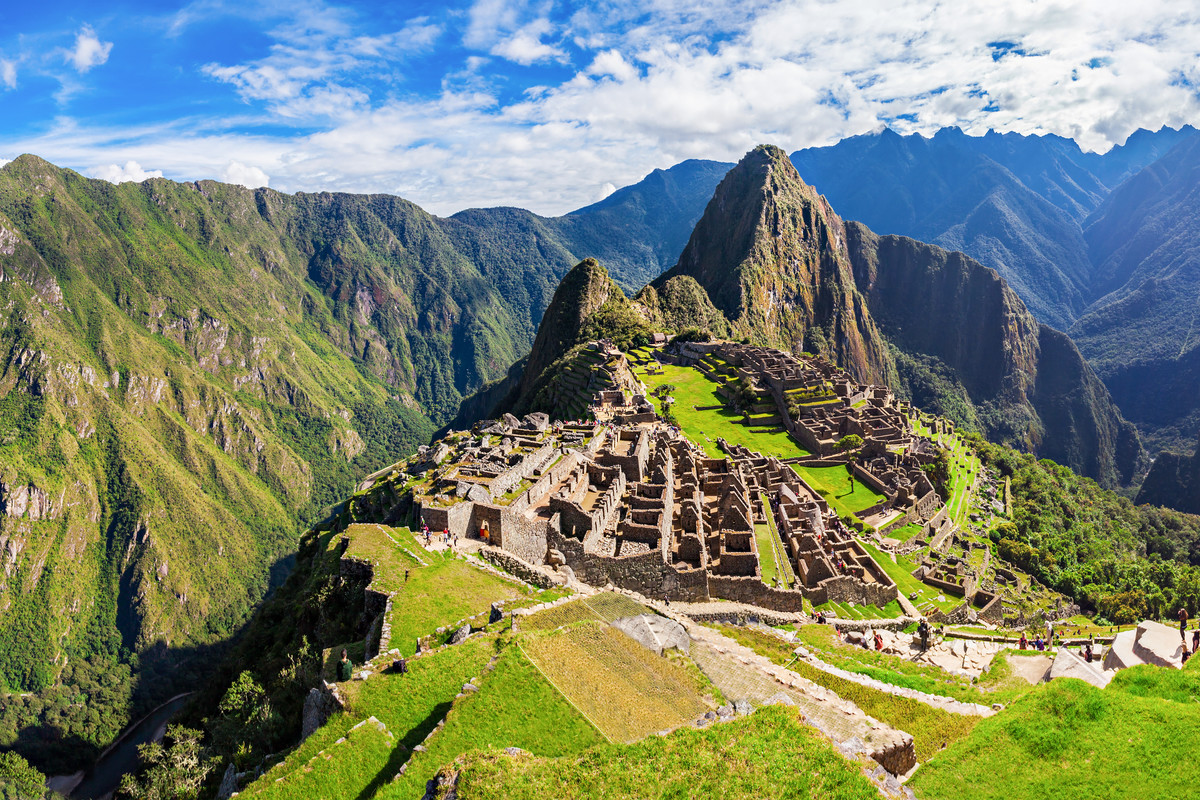
Wake up to breakfast at the hotel then transfer to the Ollanta station to begin your trip to Machu Picchu. Enjoy the approximately two-hour scenic train ride to Aguas Calientes, also known as ‘Machu Picchu Pueblo’, the last stop before entering the most important archaeological site in Peru. In Aguas Calientes, you’ll find a craft market, restaurants, and, for those who prefer to spend the night at the foot of the mountain and climb early in the morning, hotels for all budgets. Take a short bus ride up to Machu Picchu, the architectural and engineering masterpiece that once served as a sanctuary and refuge for the Inca ruler Pachacútec. Machu Picchu, which means "Old Mountain", is a UNESCO-listed World Heritage Site and one of the seven new wonders of the world. Return to Aguas Calientes for lunch and then board the train back to Cusco. Overnight in Cusco.
Hotel: Tierra Viva Cusco 3* (or similar) -
Day 10
Cusco
Wake up to breakfast in the hotel, and then enjoy a guided tour of the former capital of the Inca Empire. The tour begins at the Santo Domingo Convent, a building constructed on the site of Coricancha, one of the most important Incan complexes dedicated to sun worship. According to historic records, the original temple walls depicted scenes of nature and were covered in gold leaf. After Coricancha, visit the imposing cathedral in the Plaza de Armas, then head to the Cusco hills, where you’ll find the fortress of Sacsayhuamán and panoramic views of Cusco. Continue on to Qenqo, an archaeological site where it is believed the Incas carried out religious rituals to improve harvests. Your tour ends in Puka Pukara, meaning ‘red fortress’ in Quechua. Puka Pukara is believed to be an ancient military site comprising numerous rooms, courtyards, baths, aqueducts and towers. At the end of the tour, you will be transferred back to your hotel. Overnight in Cusco.
Hotel: Tierra Viva Cusco 3* (or similar) - Day 11 Cusco - Return After finishing your breakfast at the hotel, you will be transferred to the airport. Although this is the last day of your journey, we hope that your memories of this remarkable region, bursting with both culture and history, will last a lifetime.
Included
Operated with bilingual English and Spanish-speaking local guide
10 nights’ accommodation
10 breakfasts
5 lunches on days 4-8
Private transfers from and to airports
Transfers from/to train stations in a shared vehicle
Roundtrip train to Machu Picchu in Expedition Service (PeruRail) or Voyager (IncaRail) for Standard and Superior category and Vistadome Service (Perú Rail) or 360° (Inca Rai) for Deluxe category
Admission to all major monuments and sightseeing attractions mentioned in the above itinerary: Casa Aliaga Cathedral and Larco Museum in Lima; Santa Catalina Monastery and Society of Jesus Church in Arequipa; Condor Cross in Valley & Colca Canyon; Uros and Taquile Islands in Puno; Pucara Racchi and Andahuaylillas on the route from Puno to Cusco; Coricancha Cathedral Sacsayhuaman Qenqo Puca Pucara and Tambomachay in Cusco; Machu Picchu on day 9 and Cusco Tourist Tax (BTC ticket)
Exclusions
Expenses of a personal nature. Alcoholic and non-alcoholic beverages during meals. Meals not stated in the programme
International flights to Peru
Domestic flights (we advise booking the first flights in the morning)
International and domestic airport departure taxes
Tips for driver and guide
Optional visits mentioned as not included
Travel Insurances
PERU, A LAND OF CONTRASTS AND DIVERSITY
Peru is a country of many faces, where landscapes and cultures unfold with remarkable intensity. From the arid Pacific coastline to the lush depths of the Amazon rainforest, passing through the imposing Andes mountain range with some of the highest peaks on the continent, travelers are constantly amazed. Peru is also an encounter with communities that have preserved their ancestral traditions, the result of an exceptional historical and cultural blend. Its cuisine, widely recognized as one of the finest and most diverse in Latin America, plays a key role in this sensory journey. At the heart of this fascinating country stands one of the Seven Wonders of the Modern World: the legendary Machu Picchu.
MAIN REGIONS
LIMA
Located along the shores of the Pacific Ocean, Lima was once known as the “Pearl of the Pacific.” In pre-Hispanic times, the valley where the capital now stands was a fertile oasis that supported agriculture and fishing. During the 17th and 18th centuries, the city flourished with elegant colonial mansions adorned with intricately carved wooden balconies, reflecting its political, strategic, and economic importance within the Spanish Empire. Discovering Lima today means grasping the complexity of a vast metropolis where each neighborhood tells a different story. Marked by strong contrasts, the city strives to reconcile rural traditions with urban modernity. Despite its apparent disorder and social challenges, Lima charms visitors with its vibrant energy, distinctive character, and the warmth of its people, always eager to share their culture and joie de vivre.
AREQUIPA
About one thousand kilometers south of Lima lies Arequipa, set at the foot of the majestic Misti volcano. Known as the “White City,” it is renowned for its elegant colonial architecture built from sillar, a pale volcanic stone. Founded in 1540, Arequipa enjoys a dry, temperate climate and a spectacular natural setting. With nearly 700,000 inhabitants, it is Peru’s second-largest city. Many religious and civic buildings, carefully restored, are now open to visitors. The Santa Catalina Monastery, a true city within a city, reveals a maze of colorful streets steeped in history. Beneath an almost perpetually blue sky, Arequipa captivates with the harmony of its architecture and the gentle rhythm of daily life.
COLCA VALLEY
A few hours north of Arequipa lies the spectacular Colca Valley. Surrounded by ancient agricultural terraces, it is carved by the Colca River, which flows through one of the deepest canyons in the world. Numerous villages dot the valley, preserving their traditional layouts, richly decorated colonial churches, and age-old festivals. The highlight of any visit is the famous Cruz del Cóndor, a natural lookout point from which visitors can observe the majestic flight of condors soaring above the canyon, with the Coropuna and Ampato volcanoes rising in the distance.
CUSCO
The Cusco region is undoubtedly one of the most fascinating areas in South America. As the former capital of the Inca Empire, it impresses with the richness of its historical heritage and the vitality of its living traditions. Today, agriculture and tourism are the region’s main economic drivers. Nearby lies the Urubamba Valley, better known as the Sacred Valley of the Incas. This strategic territory once played a central military, religious, and agricultural role. Powerful fortresses built into the mountainsides protected access to the valley. Among the most remarkable sites are Pisac and Ollantaytambo, striking examples of Inca engineering. Further along, at nearly 2,900 meters above sea level, the citadel of Machu Picchu emerges from the heart of lush tropical vegetation.
SACRED VALLEY
Stretching just a few kilometers from Cusco, the Sacred Valley benefited from a mild climate and fertile land that made it the breadbasket of the Inca Empire. The valley also held strategic importance as the gateway between the Andes and the Amazon rainforest. Its atmosphere is truly unique, blending the serenity of cultivated landscapes with the power of dramatic mountain scenery. Here, the glorious past of Inca civilization coexists with a present that remains rural, authentic, and deeply alive.
MACHU PICCHU
Visiting Machu Picchu evokes an emotion comparable to standing before the pyramids of Egypt. Even before catching sight of the citadel, travelers are immersed in a sense of anticipation, as the site reveals itself only at the last moment. Considered one of the greatest masterpieces of landscape architecture in the world, Machu Picchu is divided into two distinct areas. The agricultural sector consists of vast terraced fields and storage facilities used to preserve food supplies. The urban and sacred sector contains temples, plazas, and royal mausoleums crafted with extraordinary precision. The harmony between human ingenuity and the surrounding natural environment gives this place an unforgettable aura.
PERUVIAN CUISINE
Peruvian cuisine enjoys international recognition and is considered one of the richest in Latin America. It delights visitors with iconic dishes such as ceviche, pachamanca, chupe de camarones, ají de gallina, and juanes. This culinary wealth is rooted in the country’s exceptional ecological diversity, which encompasses a large proportion of the world’s known life zones. Abundant marine resources provide exceptionally fresh fish and seafood, while the Andes supply an astonishing variety of potatoes, corn, and chili peppers. The Amazon rainforest contributes unique ingredients, including river fish, game, and tropical fruits. This gastronomic heritage is the result of remarkable cultural blending, combining Spanish, African, Arab, Italian, Chinese, and Japanese influences. Today, a new generation of chefs is reinterpreting these traditions with creativity, giving rise to a refined and innovative contemporary cuisine.
TRANSPORTATION
Peru continues to develop its transportation infrastructure, both by land and by air. The domestic airline network allows travelers to quickly reach the country’s main tourist destinations. Road transportation, primarily provided by interprovincial buses, covers nearly the entire territory, with the exception of some remote areas of the Amazon. Travelers choosing a self-drive itinerary must carry a valid driver’s license, a copy of their passport, and their vehicle rental agreement. Taxis are widely available in Peruvian cities, though it is recommended to use official taxi companies for safety reasons.
FACT SHEET
Peru covers an area of 1,285,215 km² and, in 2015, had a population of over 30 million people, the majority living in urban areas. Spanish is the most widely spoken language, alongside Quechua, Aymara, and other Indigenous languages. The population is predominantly Catholic, although other religious affiliations are also present. Peru is a democratic republic, with the president and members of Congress elected every five years. The national currency is the Peruvian sol. Electrical current is 220 volts, with type A, B, or C outlets. Peru can be visited year-round, although certain seasons are more favorable depending on the region. The country is divided into three major geographical zones: the Pacific coast, the Andes mountains, and the Amazon rainforest.
The Embassy of Canada is located in Lima.
Name: Essentials of Peru
Brand: Pathways of the World
Quality: First Class
Tour Type: Escorted
Start City: Lima
End City: Cuzco
Vacation Overview:
Explore Peru and discover its heritage, fauna and inhabitants during 11 dreamy days of crossing the country. This unforgettable circuit from and to Lima invites you to visit beautiful colonial cities, archaeological sites left by ancient civilizations and some of the most spectacular landscapes on the planet. Admire the condor of the Colca Valley and the native camelids of the Andes. Discover the Sacred Valley of the Incas, travel back in time on the islands of Lake Titicaca and ascend Machu Picchu, the ‘lost city of the Incas