



Call to speak with one of our Tour Experts 1-877-230-8747
-
 Kevin Dupuisx7374
Offline
Kevin Dupuisx7374
Offline
-
 Jairus Mausx7365
Offline
Jairus Mausx7365
Offline
-
 Robyn Murrayx7215
Offline
Robyn Murrayx7215
Offline
-
 Victoria Guestx7121
Offline
Victoria Guestx7121
Offline
-
 Cindy Callaghan
Offline
Cindy Callaghan
Offline
-
Day 1
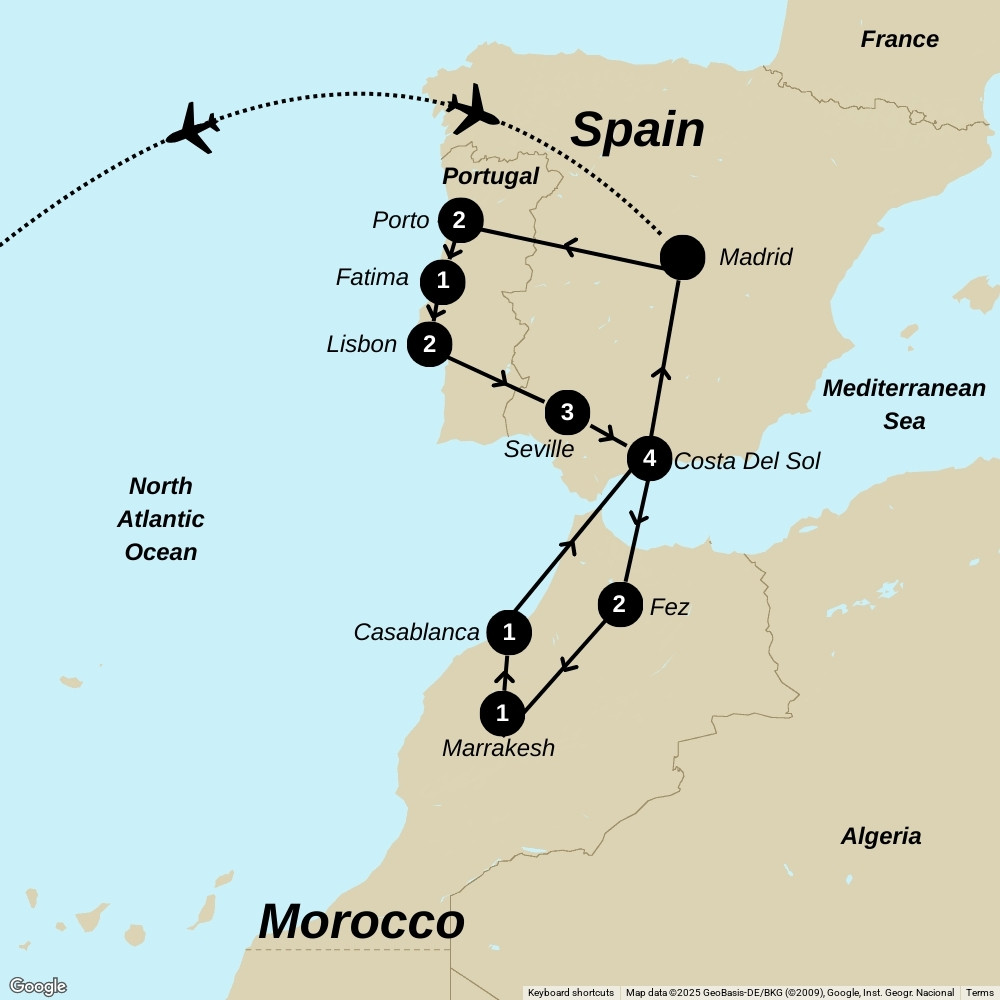
Madrid - Salamanca - Porto
Join the group at the meeting point at 8:30 in the morning (Departure from established hotels in Madrid. Please refer to your documentation for detailed departure information). From there, drive to Salamanca. Here you can spend some free time wandering around this World Heritage University City of great architectural and artistic value. Afterwards, drive across the Portuguese border until reaching Porto, where you will check in to your hotel for the night. Overnight in Porto
Hotel ( Superior): Vila Gale Porto 4* (or similar) -
Day 2
Porto
Breakfast at the hotel. Panoramic sightseeing tour of Porto, considered World Heritage city. We admire the Cathedral, Stock Exchange building and Santa Clara church. Afterwards, enjoy a different perspective of the city along the river Douro aboard the cruise and discover the historic heritage by visiting one well known Port Wine Cellars with a wine tasting included. Rest of day at leisure. Overnight in Porto
Hotel ( Superior): Vila Gale Porto 4* (or similar) -
Day 3
Porto - Coimbra - Fatima
Enjoy a leisurely breakfast at the hotel and then depart to your next destination: Coimbra, home to one of the oldest universities in Europe and the birthplace of Fado. After some free time wandering around the city, continue to Fatima, a world-renowned centre for the Christian Faith and a World Pilgrimage Sanctuary. Contemplate its impressive Basilica and the Cova da Iria, the legendary place where the Virgin Mary miraculously appeared. The Chapel of the Apparitions, heart of the sanctuary, contains the tombs of the three shepherds who witnessed the miracle, Lucia, Francisco and Jacinta. At night, conditions permitting, you have the option to attend the procession of the candles. Overnight in Fatima.
Hotel ( Superior): Santa Maria 4* (or similar) -
Day 4
Fatima - Lisbon
After breakfast at the hotel, hit the road and drive to the Batalha Monastery, a masterpiece of the Gothic and Manueline styles, listed as a World Heritage place by UNESCO. Continue then to the picturesque fishing town of Nazaré, where you’ll spend some free time absorbing its quint atmosphere. Continue later to Alcobaça, yet another World Heritage site, and visit its famous 12th-century church and the tombs of Pedro and Inés de Castro. Then one last drive takes you all the way to Lisbon, where you’ll check in and spend the night. There is an optional night tour to attend a show of Fado, typical Portuguese song and music. Overnight in Lisbon.
Hotel ( Superior): Lutecia 4* (or similar) -
Day 5
Lisbon
Breakfast at the hotel is followed by a morning sightseeing tour of the ancient Olissipo, as Lisbon was known in Roman times. Drive through its main squares and avenues, and see renowned landmarks like the Belem Tower, the Jeronimos Monastery, the Coach Museum, the Monument to the Discoverers, Marquis of Pombal Square and Liberty Avenue. Spend the afternoon at leisure wandering through the nostalgic corners of the Alfama Quarter, the old city gathered next to the city castle, with old buildings nested in narrow twisting “Ruas” of coloured houses and genuine "tabernas” playing Fado late into the night. Overnight in Lisbon.
Hotel ( Superior): Lutecia 4* (or similar) -
Day 6
Lisbon - Merida - Cordoba
After breakfast at the hotel depart towards Merida, the capital of Extremadura. Declared a World Heritage Site, Merida is renowned for its rich historical heritage, including its well-preserved Roman ruins: the theater, the amphitheater, the Roman bridge, and more. Free time and then continue to Córdoba, once the capital of the Caliphate. Overnight in Cordoba
Hotel ( Superior): Eurostars 4* (or similar) -
Day 7
Cordoba - Seville
Begin the day with breakfast at the hotel before hitting the streets to join a tour of this fascinating historical city. Admire its impressive “Mosque” – today reconverted into a Cathedral – and a great many other interesting sites. Ease your mind and spirit by strolling through the narrow winding streets of the Jewish Quarter. In the afternoon, after a short two-hour ride, reach Seville, where you’ll check in. Overnight in Seville
Hotel ( Superior): Melia Lebreros 4* (or similar) -
Day 8
Seville
After breakfast at the hotel, head out on a morning panoramic tour of the city. Marvel at the exterior of the second largest cathedral in the Catholic world after St. Peters in Rome, before continuing to explore the Santa Cruz quarter. This charming neighbourhood is a natural setting for “Carmen” and where the myth of “Don Juan” developed. Later visit Maria Luisa Park and Plaza de España. The afternoon is free for you to spend at leisure discovering exclusive views or specific flavours of this lively city. Overnight in Seville
Hotel ( Superior): Melia Lebreros 4* (or similar) -
Day 9
Seville - Ronda - Costa Del Sol
Recharge your batteries with breakfast at the hotel and then drive south passing by a number of charming typical villages. Reach Ronda and enjoy some free time admiring this town of Celtic origin and the marvellous view it offers of the valley and surrounding mountain range. In the afternoon, continue to the Costa del Sol, one of the most modern and important international tourist areas in this part of Spain. During the stay in Costa del Sol tour escort service will not be available. Overnight in Costa del Sol
Hotel ( Superior): Sol Torremolinos 4* (or similar) -
Day 10
Costa Del Sol
Have breakfast at the hotel and then enjoy a full day to yourself in which you get to explore the wonderful beaches of the Costa del Sol and the surrounding areas at your own rhythm. There are also a number of available optional tours for you to choose from, should you be feeling slightly more adventurous and not quite up to a lazy day of swimming and sunbathing. During the stay in Costa del Sol tour escort service will not be available. Overnight in Costa del Sol
Hotel ( Superior): Sol Torremolinos 4* (or similar) -
Day 11
Costa Del Sol - Tarifa/Algeciras - Tangier - Fez
After breakfast at the hotel, drive along the picturesque tourist route of Costa del Sol until arriving in Tarifa or Algeciras, where you board a ferry boat to cross the strait of Gibraltar and reach North Africa. Disembark in Tangier, clear customs and drive to Fez making a brief stop in Meknes. Dinner and overnight at the hotel. Overnight in Fez
Hotel ( Superior): Royal Mirage 4* (or similar) -
Day 12
Fez
Breakfast at the hotel. Enjoy a morning city tour of the most ancient and monumental of the Imperial Cities visiting the most interesting points: the 7 gates of the Royal Palace, Jewish Quarters or Mellah, the gate of Bab Bou Jelous and a walking tour of the “Medina” (Old City), declared World Heritage Site. Afternoon free and dinner at the hotel. Optional dinner with show. Overnight in Fez
Hotel ( Superior): Royal Mirage 4* (or similar) -
Day 13
Fez - Rabat - Casablanca - Marrakech
After breakfast, head to Rabat, the capital of the country. Visit the exterior of the Royal Palace, the Mohamed V Mausoleum and the Hassan Tower. Continue to Casablanca to visit the most interesting places, such as the United Nations Square, the Boulevard de la Corniche and the exteriors of the Hassan II mosque. After some free time for lunch continue to Marrakech. There’s also an optional dinner and show available at Chez Ali Fantasia. Overnight in Marrakech
Hotel ( Superior): Kenzi Rose 5* (or similar) -
Day 14
Marrakech - Casablanca
Wake up to breakfast at the hotel and then visit the city called “Pearl of the South”, which begins in the grandiose Menara Gardens, which have a side pavilion and countless olive trees. Afterwards, visit an exterior of the Koutoubia minaret, twin sister of the Giralda in Seville. Once inside the old part of the city, we visit the Bahia Palace, property of a nobleman of the city. Finally arrive at the Jemaa el Fna square, one of the most interesting places in Morocco, from where you can access the souks and the medina. After the visit, lunch at the hotel in Marrakech and departure to Casablanca. Dinner and overnight at the hotel. Overnight in Casablanca
Hotel ( Superior): Grand Mogador City Center 5* (or similar) -
Day 15
Casablanca - Tangier - Tarifa/Algeciras - Costa Del Sol
After breakfast at the hotel, depart to the pier in Tangier, where you’ll hop onto a ferry to take you back across the strait of Gibraltar to Spain. Then drive back up the way you came and return to Costa del Sol. Spend the rest of the day at leisure. Overnight in Costa del Sol
Hotel ( Superior): Sol Torremolinos 4* (or similar) -
Day 16
Costa Del Sol
Have breakfast at the hotel and enjoy yet another full day to yourself in the Costa del Sol. Enjoy its wonderful beaches and the surrounding areas at your own rhythm, or make the most of the services available at the hotel. There are also a number of available optional tours for you to choose from. Overnight in Costa del Sol
Hotel ( Superior): Sol Torremolinos 4* (or similar) -
Day 17
Costa Del Sol - Granada
Wake up to breakfast in the hotel before departing towards Granada and its incredible monumental environment, last stronghold of the Moorish Kingdoms up to 1492. Once you set foot in this historical city, visit the world-famous Generalife Gardens that have inspired several authors with its sound and sights, such as the well-known “Tales of the Alhambra” by W. Irving. Overnight in Granada.
Hotel ( Superior): Catalonia Granada 4* (or similar) - Day 18 Granada - Toledo - Madrid - Return Enjoy one last breakfast at the hotel and then drive northward to the impressive Imperial city of Toledo. See it emerge from the horizon and reach for the sky of Castile. Enveloped in the embrace of the Tagus River, this UNESCO-listed World Heritage City was once the home of members of the three Abrahamic religions: Christians, Muslims and Jews. A mélange of Spanish art, history and spirituality, the whole town is a National Monument. Join a guided tour of this historical town and lose yourself in the beauty of its narrow streets. Continue then to Madrid, where the tour reaches its conclusion. Breakfast included.
Included
17 nights’ accommodation
17 breakfasts
1 lunch (day 14)
3 dinners (day 11 12 14)
Motor-coach during the whole program
Ferry
All entrance fees and activities mentioned in the itinerary: guided tour in Porto guided tour of Lisbon city tour in Cordoba (incl. Mosque-Cathedral entrance) city tour in Seville (incl. Cathedral entrance) visit to Generalife Gardens and Alhambra in Granada guided tour of Fez guided tour of Marrakech panoramic guided tour of Casablanca guided tour of Rabat and guided tour of Toledo.
Travel Insurance
Exclusions
Items of a personal nature such as alcoholic drinks laundry drinks and meals not stated explicitly in the programme.
Any others expenses which are not mentioned in the included section.
National or International flights.
All types of insurance except of mentioned Travel Insurance.
Entry visas to Spain and Gibraltar (if applicable).
Entrance tickets to any venue museum or activity not mentioned.
Only one piece of luggage per person is allowed. Passengers have to go through customs control with their own luggage.
Lisbon and Porto Local City Tax is not included to be paid directly to the hotel.
TRAVELING IN MOROCCO
A North African country bordered by the Atlantic Ocean to the west and the Mediterranean Sea to the north, Morocco occupies a strategic position between Europe, Africa, and the Arab world. It shares land borders with Algeria to the east and Mauritania to the south, separated by Western Sahara. A constitutional and parliamentary monarchy, the country is governed from its administrative capital, Rabat.
Morocco reveals itself as a mosaic of landscapes, cultures, and atmospheres. It is traditionally divided into three major tourist regions: the Atlantic and Mediterranean coastlines, the vast desert regions of the south, and the historic imperial cities. This geographical and cultural diversity makes every itinerary unique and remarkably complete. An Arab country of over 30 million inhabitants, Morocco is also distinguished by its linguistic richness, where Arabic and Amazigh naturally coexist with French and, in certain northern regions, Spanish.
Among the countries of the Maghreb, Morocco stands out for the dramatic relief of its mountain ranges—particularly the Atlas Mountains—and the breadth of its fertile plains. Travelers are constantly struck by contrasts, moving within a few hours from Atlantic beaches to snow-capped peaks and onward to the dunes of the desert.
GENERAL INFORMATION
The capital of Morocco is Rabat, and the country covers an area of approximately 446,550 km². Two languages are officially recognized: Arabic and Amazigh, both spoken in various dialects depending on the region. The Moroccan dirham (MAD) is the national currency. Payments can be made in cash or by credit card, although cash remains widely preferred in markets and small shops.
Haggling is an integral part of Moroccan commercial culture, especially in the souks. Prices quoted to visitors are often higher than local rates, but negotiation is expected and usually conducted in a friendly atmosphere. Comparing prices, taking one’s time, and bargaining with humor and a smile often lead to a satisfying agreement for both parties.
Morocco’s international dialing code is +212. The country is five hours ahead of Montreal. Electrical outlets operate at 220 volts.
DID YOU KNOW…
Morocco has the largest exploitable argan forest area in the world, mainly concentrated around Essaouira and Agadir. These unique trees produce argan oil, prized for both its culinary and cosmetic properties. Mount Toubkal, rising to 4,167 meters, is the highest peak in North Africa. Moroccan cuisine is considered one of the world’s most refined, often compared to French and Chinese gastronomy. In 2019, Morocco also became the first African country to introduce a high-speed train, connecting Tangier to Casablanca in under an hour and a half.
CASABLANCA
Casablanca, nicknamed the White City, is Morocco’s largest city and its main economic hub. Located on the Atlantic coast, about 80 kilometers south of Rabat, it combines modernity with colonial heritage. Its architecture reflects different eras, blending Art Deco, European influences, and contemporary buildings. A dynamic and lively city, Casablanca hosts numerous cultural, artistic, and economic events throughout the year and offers a vibrant urban lifestyle.
RABAT
Rabat stretches along the Atlantic coast at the mouth of the Bouregreg River. On the opposite bank lies the city of Salé, now considered a residential district of the capital. Together, they form a metropolitan area of over 1.5 million inhabitants. Rabat stands out for its elegance, historical monuments, and calmer atmosphere compared to other major cities. As the administrative and political capital, it also boasts a rich cultural and architectural heritage.
TANGIER
Located at the northern tip of the country, Tangier holds a unique position overlooking the Strait of Gibraltar. A true gateway to Africa, the city has undergone rapid modernization while preserving its cosmopolitan identity. Today, Tangier is Morocco’s second economic center, thanks in part to the Tanger Med port, its free trade zone, and its proximity to Europe. This momentum is reflected in modern infrastructure and a growing tourism sector.
THE RIF REGION
The Rif region extends along the Mediterranean coast from Tangier to the Moulouya Valley. It features a mountainous landscape interspersed with plains and traditional villages. The region is divided into the Eastern Rif, Central Rif, and Western Rif, each with its own cultural and scenic characteristics. Chefchaouen, with its blue-painted streets, and Al Hoceima, facing the sea, are among the most popular destinations in this authentic region.
FEZ
Located in the north of the country, Fez is Morocco’s third-largest city and one of its oldest. Founded at the end of the 8th century, it long served as the capital of the kingdom and is still considered its spiritual heart. Its medina, listed as a UNESCO World Heritage Site, is a living labyrinth where traditional crafts, Quranic schools, and historic mosques coexist in an atmosphere seemingly frozen in time.
MEKNES
Meknes is an imperial city shaped by the reign of Sultan Moulay Ismail in the 17th century. It preserves many vestiges from this era, including the impressive Bab Mansour gate and the vast Heri es-Souani complexes. Less touristy than Fez or Marrakech, Meknes offers a quieter discovery, ideal for appreciating Moroccan history and architecture.
MARRAKECH
Marrakech is undoubtedly Morocco’s most iconic city. A former imperial capital, it is now a major economic, cultural, and tourist center. Its fortified medina, bustling souks, and the famous Jemaa el-Fna square immerse visitors in a unique atmosphere. The minaret of the Koutoubia Mosque, visible from afar, dominates the city, while palaces, gardens, and riads testify to the richness of its past.
HIGH ATLAS
The High Atlas Mountains cross Morocco from southwest to northeast and form the country’s backbone. This spectacular mountain range offers grand landscapes of snow-capped peaks, green valleys, and Berber villages clinging to hillsides. It is an ideal region for hiking, cultural discovery, and immersion in a more rural Morocco.
OUARZAZATE
Ouarzazate, located south of the High Atlas, is often referred to as the gateway to the desert. The city is famous for the Taourirt Kasbah and for its surrounding landscapes, which have served as settings for numerous international films. Nearby are the UNESCO-listed ksar of Aït Ben Haddou, the Todra Gorges, and the Draa Valley, lined with lush palm groves.
ZAGORA
Zagora lies in the Draa-Tafilalet region and is one of the traditional departure points for desert excursions. The modern town developed during the French protectorate and today retains a peaceful atmosphere focused on Saharan tourism and journeys into the dunes.
AGADIR
Agadir is a well-known seaside resort on the southern Atlantic coast. Rebuilt after a devastating earthquake in 1960, the city now offers modern infrastructure, a long sandy beach, and a lively seaside promenade. Its mild climate year-round makes it a popular destination for beach stays, golf, and relaxation.
CUISINE
Moroccan gastronomy is world-renowned for its richness and refinement. It reflects the country’s history and the blending of Berber, Arab, Andalusian, and Mediterranean influences. Couscous and tagine are among the most iconic dishes, though each region offers its own specialties. Pastilla, originating from Fez, perfectly illustrates the Moroccan art of combining sweet and savory flavors. Mint tea, a symbol of hospitality, accompanies all moments of daily life.
SHOPPING AND SOUVENIRS
Moroccan souks are true Ali Baba’s caves, filled with colors, scents, and ancestral craftsmanship. Visitors will find a wide variety of handmade products such as carpets, ceramics, spices, oils, silver jewelry, babouches, and leather goods. These souvenirs, often crafted by hand, are authentic expressions of local heritage.
SAFETY
Morocco is considered a safe country for travelers. Serious incidents are rare, and tourist police are present in the main visitor areas. Normal vigilance is nevertheless recommended, particularly in crowded places. Travelers are advised to keep valuables secure and adopt sensible behavior without excess concern.
HEALTH ADVICE
Before departure, it is recommended to be up to date with routine vaccinations and to consult a travel health clinic. Some illnesses related to food and water may occur, making hygiene precautions and bottled water essential. Additional precautions may be required for extended stays or travel in rural areas.
CLIMATE
Morocco’s climate varies greatly by region. It is Mediterranean in the north, Atlantic along the west coast, and desert in the south. The best times to visit are generally spring and autumn, when temperatures are milder. Summers can be extremely hot, especially inland, while winter offers mild conditions along the coast and cooler temperatures in the mountains.
RELIGION AND BELIEFS
Sunni Islam is the dominant religion in Morocco, practiced according to the Maliki rite, known for its relative flexibility. Religion plays an important role in daily life and structures the calendar through its festivals and prayers. Certain popular traditions, such as the veneration of marabouts, reflect an ancient cultural heritage blending religious belief with local practices.
ETIQUETTE AND CUSTOMS
Moroccan society places great importance on respect, hospitality, and human relationships. Polite gestures, accepting offered tea, and discretion in religious spaces are essential. Asking permission before photographing someone and dressing modestly, especially in rural areas, are appreciated. Learning a few words of Arabic or Amazigh is always warmly welcomed and greatly facilitates interaction with the local population.
Name: Portugal, Andalusia & Morocco
Brand: tripcentral tours
Quality: Tourist Class
Tour Type: Escorted
Start City: Madrid
End City: Madrid
Vacation Overview:
Over eighteen fascinating days you will discover the cultural riches of three countries: Spain, Portugal and Morocco. Starting in Andalusia, explore its legacy from Phoenician times all the way through the Roman, Muslim, Jewish and Christian periods. Visit spellbinding World Heritage sites such as Seville’s Alcazar and Cathedral, Cordoba’s Great Mosque and Granada’s Alhambra. Then explore Portugal’s most enchanting cities, beginning with a religious pilgrimage. See the first Portuguese Gothic-style church in Alcobaca, admire the Monastery of Santa Maria da Vitoria, and attend the candle-lit procession at the Marian Shrine in Fatima. Explore one of the world’s oldest universities in Coimbra, stroll through the alleys of Alveiro, and make a stopover in Oporto,an acclaimed UNESCO World Heritage site. Lastly, see the magic and mystique of Morocco come to life in the impressive imperial cities of North Africa’s last kingdom. Visit the awe-inspiring cities of Marrakech, Fes, Meknes, Rabat and Casablanca.