



Call to speak with one of our Tour Experts 1-877-230-8747
-
 Eliana Antonx7167
Offline
Eliana Antonx7167
Offline
-
Day 1
Aswan
Arrival in Aswan. Meet and assist at Aswan airport and transfer to your hotel in Aswan.
OPTIONAL: Philae Temple, High Dam & unfinished Obelisk
Take a short motorboat ride to visit the Temple of Philae, built in honour of Isis, one of the great mother goddesses of Ancient Egypt. This beautiful temple was moved, with the help of UNESCO, to its present location on Agilka Island to save it from the rising waters caused by the construction of the High Dam. Its construction in the 1960’s was somewhat controversial due to the loss of Nubian villages and temples which now lie under Lake Nasser, the world’s largest artificial lake. However, the resulting electricity generated by the dam supplies the whole of Egypt.
You will also stop at the stone quarries to see the Unfinished Obelisk, the largest known ancient obelisk. Here, listen to your guide as they explain the methods used by ancient craftsmen to create impressive moments and see marks from workers' tools, which are still clearly visible on the bedrock.
Overnight in Aswan.
Tour options & excursions available
Philae Temple, High Dam & unfinished Obelisk
Price: contact us
Sound and light at Philae temple including roundtrip transfers
Price: contact us
Hotel: Basma Hotel (or similar) -
Day 2
Aswan
Abu Simbel Temples
Breakfast at the hotel.
Early morning transfer to Abu Simbel by road (3 hours one way) or by flight (flight duration 45 minutes one way)
As you approach the entrance to Abu Simbel temple, notice the four enormous statues of Pharaoh Ramses II that look out over Lake Nasser, which are carved from one piece of rock. The temple is dedicated to the god Ra-Hurakhti and was built by Ramses II during the 13th century BC. The walls inside depict the pharaoh in his various exploits and next door is the temple that Ramses dedicated to his favorite wife, Nefertari.
Check out and transfer to the cruise ship.
Return to Aswan, board the ship.
Lunch on board.
Return to the boat for dinner.
Overnight on board.
Tour options & excursions available
Felucca Ride (excluding transfers): In the afternoon, Felucca Ride Sailing trip on the Nile in a typical Egyptian sailing boat, around Elephantine Island which hold the ruins of Yebu, as well as an ancient Nilo-meter, the Botanical Gardens of Lord Kitchener, a former Consul General in Egypt with a passion for flowers, and the Agha Khan Mausoleum, the burial place of the former leader of the Ismaili Muslims. « less
Price: contact us
Abu Simbel by flight Supplement
Price: contact us
Hotel: MS Sara, Sonesta Nile Cruise, Jaz Monarch (or similar) -
Day 3
Aswan - Kom Ombo
Kom-Ombo Temple
Morning at leisure in Aswan to discover the city on your own.
Lunch on board and departure of the cruise to Kom-Ombo for a visit the magnificent Temple of Kom-Ombo. The temple is dedicated to two gods and has two parallel axial passages running through its columned halls, terminating in two sanctuaries, one for each god. The southern axis (on the right) is dedicated to the crocodile god Sobek, and the northern (on the left) Harwer’s. The temple stands at a bend in the Nile where, in ancient times, sacred crocodiles basked in the sun on the riverbank.
Afternoon tea on board while you cruise to Edfu.
Continue to cruise towards Esna.
Dinner and overnight on board.
Tour options & excursions available
Edfu Temple: Visit the Temple of Edfu, one of the last great monuments of Egypt, in better condition today than the temples of Karnak, Luxor and Abydos. It is one of a few temples that gives access to the roof, from which you get a wonderful view over the Nile and surrounding fields, with wonderful views from its rooftop. « less
Price: contact us
Hotel: MS Sara, Sonesta Nile Cruise, Jaz Monarch (or similar) -
Day 4
Luxor
Luxor Temple, Valley of the Kings
Breakfast buffet on board during sailing to Luxor.
Arrival in Luxor and departure for the visit of Luxor Temple. Built by Amenhotep III in 1380 BC, the site was added to by later pharaohs. The temple enjoyed many celebrations, the most important being the Festival of Opet which lasted almost a month.
Lunch on board of the ship.
In the afternoon, we visit the Valley of the Kings on the West Bank of Luxor. The Valley of the Kings is a vast City of the Dead where magnificent tombs were carved into the desert rocks, decorated richly, and filled with treasures for the afterlife by generations of Pharaohs. Pass by the famed Colossi of Memnon, known in Ancient Greek times for their haunting voices at dawn.
Return to the boat for afternoon tea.
Tonight's farewell dinner will be a gala dinner ,serving gourmet cuisine followed by a belly dancer.
Overnight on board.
Tour options & excursions available
Entry ticket to Tutankhamon tomb at the Valley of the Kings
Karnak Temples (ask your Guide for your free bike ride by the Temple!): Continue to the Temple of Karnak, built over more than a thousand years by generations of Pharaohs. The great “Hypostyle Hall” alone is a veritable forest of giant pillars rising 23 meters toward the sky. At the “Sacred Lake,” priests purified themselves in the waters before performing rites at the temple. At the height of its glory, Karnak Temple collected annual tribute from over 65 cities in the region. « less
Entry ticket to Ramses VI tomb at the Valley of the Kings
Hot air Balloon including roundtrip transfers
Sound and Light at Karnak with transfers
Entry ticket to King Seti I tomb at the Valley of the Kings
Prices: contact us
Hotel: MS Sara, Sonesta Nile Cruise, Jaz Monarch (or similar) -
Day 5
Luxor - Hurghada
Breakfast on board.
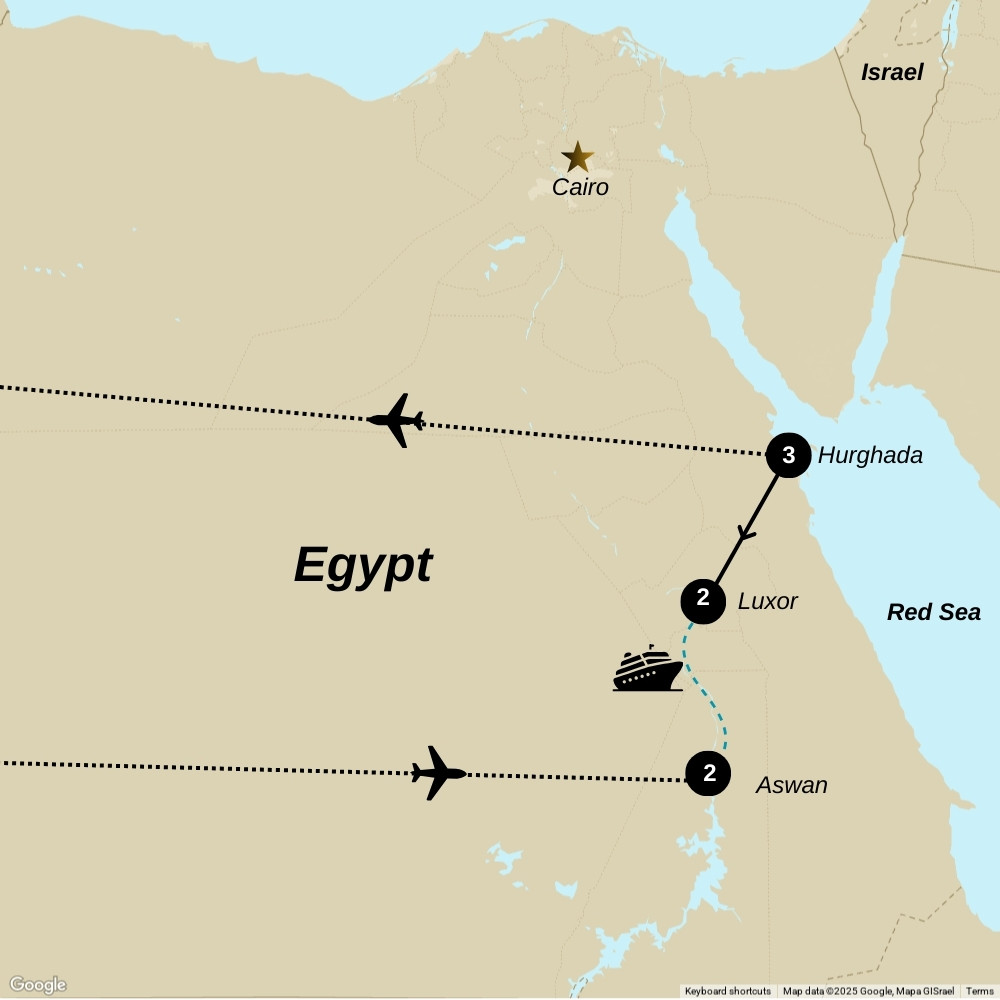
Disembarkation and transfer to Hurghada on the Red Sea.
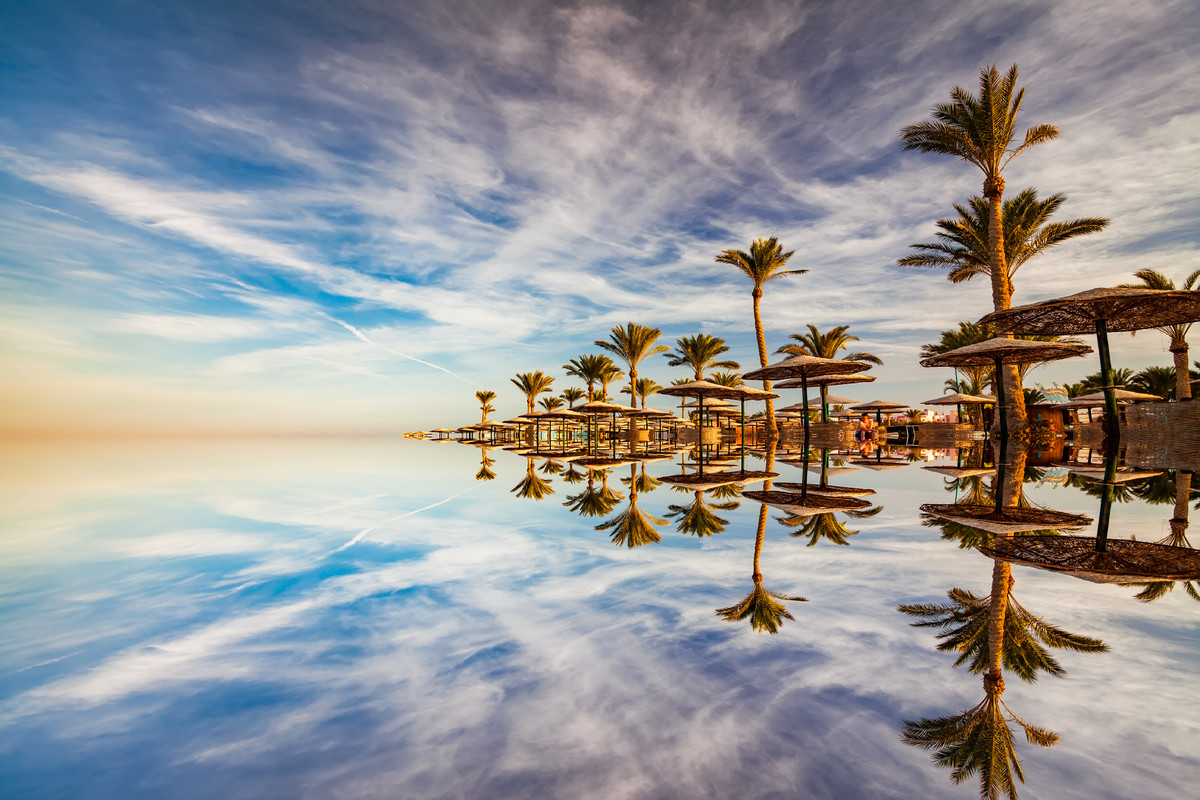
Nestled on the Gulf of Suez, Hurghada is one of Egypt's busiest beach resorts with many hotels. Diving is the main attraction since the area is famed for its reefs, and nearby Giftun Island is a snorkeler's paradise. If you want to experience a bit of history, the nearby monasteries of St. Paul and St. Anthony are worth a day trip.
Arrival in Hurghada, check in to the hotel for 3 nights on all inclusive basis
Overnight in Hurghada.
Hotel: Mercure Hurghada Hotel (or similar) -
Day 6
Hurghada
Free day for Leisure. Why not take an optional snorkeling tour?
Breakfast, lunch and dinner at the hotel.
Overnight: At your hotel in Hurghada.
Tour options & excursions available
Full day trip to Paradise Island, incl lunch & snorkeling
Full day Orange Bay incl lunch and snorkeling
Quad ride and barbecue at sunset
Full day Mega safari (quad, spider car, jeep, camel ride 10mins, dinner)
2 hours Horse Riding tour
Half day Hurghada City tour
Full day trip to Mahmeya Island, incl lunch & snorkeling
Prices: contact us
Hotel: Mercure Hurghada Hotel (or similar) -
Day 7
Hurghada
Free day for Leisure. Why not take an optional safari or a city tour?
Breakfast, lunch and dinner at the hotel.
Overnight: At your hotel in Hurghada.
Hotel: Mercure Hurghada Hotel (or similar) -
Day 8
Return
Transfer by air-conditioned vehicle to Hurghada airport.
Tour options & excursions available
Domestic Flights Cairo – Aswan / Hurghada – Cairo
Price: contact us
Included
7 nights accommodation: 1 night in Aswan on bed and breakfast basis; 3 nights on the cruise ship in full board​; 3 nights in Hurghada on all inclusive basis as per hotel formula
Airport transfers in modern Air-conditioned vehicle with service of Tour coordinator escorting clients from each point to the next destination​
All tours as described in the program with shared English-speaking Egyptologist guide
All the admissions for the sightseeing stated in the program​
All applicable local taxes
Exclusions
International and domestic Flights​
Entry visa to Egypt​
Any beverages and meals not mentioned within the program
All gratuities & tips during the trip​ (see note below)
Camera ticket at sites as required​​
Traveling to Egypt
General Overview
A land of legends and one of the greatest cradles of civilization, Egypt has fascinated travelers for thousands of years. Long before modern tourism existed, Greeks and Romans were already journeying along the Nile to marvel at temples, tombs and monuments left behind by a civilization that spanned more than two millennia. Even today, Egypt continues to inspire awe through the sheer scale of its history, the power of its landscapes and the timeless presence of the Nile.
From the monumental pyramids to the bustling souks, Egypt is a country of contrasts. Ancient wonders coexist with vibrant daily life, where tea is shared on café terraces, shisha smoke drifts through narrow streets, and mosques rise beside crowded neighborhoods. Figures such as Tutankhamun, Cleopatra and Alexander the Great continue to fuel the imagination, while colossal statues, papyrus-like columns and richly decorated tombs bring the past vividly to life. Egypt is not a country to simply observe—it is a country to experience, to understand through its people, and to feel through its rhythm.
Cairo
Cairo, the capital of Egypt, is the most populous city in Africa. At first glance, it can feel overwhelming—noisy, chaotic, polluted and intense. Yet beneath this apparent disorder lies a magnetic energy that draws travelers in. Cairo has a soul, an indefinable charm that slowly reveals itself to those willing to explore.
The city is home to some of Egypt’s greatest treasures: the Egyptian Museum, the pyramids of Giza, the vast necropolis of Saqqara and the winding streets of Islamic Cairo. Often the first stop on a journey through Egypt, Cairo serves as an initiation into the country’s culture—both ancient and modern—before travelers continue south along the Nile.
The Sphinx
Standing guard east of the Pyramid of Khafre for over 4,500 years, the Great Sphinx of Giza remains one of Egypt’s most enigmatic monuments. Carved directly from limestone, this colossal figure—73 meters long and 20 meters high—faces the rising sun and watches over the Giza necropolis. Its missing nose, often the subject of myths, was damaged long after antiquity, likely during the Mamluk period. Timeless and mysterious, the Sphinx continues to inspire fascination and debate.
The Pyramids of Giza
The pyramids of Giza are among the most powerful symbols of human achievement. Built more than 4,500 years ago, the pyramids of Khufu, Khafre and Menkaure remain an architectural and archaeological mystery. Admired by travelers since antiquity, they represent the oldest major tourist site on Earth and stand as a testament to the ingenuity of ancient Egypt.
Aswan
Aswan marks the southern gateway to Egypt and forms a natural bridge between Nubia and Africa. The city is known for its relaxed atmosphere, warm hospitality and striking Nile scenery. Visitors can explore the colorful souk, visit the exceptional Nubia Museum, or take a boat to Elephantine Island, home to Nubian villages and archaeological remains.
Nearby lies the Temple of Philae, dedicated to the goddess Isis, beautifully relocated to protect it from rising waters. Aswan is also a starting point for felucca rides on the Nile, offering unforgettable moments of calm and beauty.
Edfu
Located on the west bank of the Nile in Upper Egypt, Edfu is famous for its remarkably preserved Temple of Horus. Built during the Ptolemaic period, this monumental sanctuary dedicated to the falcon god impresses with its massive pylons, towering walls and detailed reliefs depicting ancient rituals. It is one of the finest surviving examples of a classical Egyptian temple.
Luxor
Once the ancient city of Thebes, Luxor is often described as the world’s greatest open-air museum. Situated along the Nile, it was the glorious capital of Pharaonic Egypt for centuries. Today, Luxor rivals Cairo as Egypt’s most visited destination.
The temples of Karnak and Luxor are monumental in scale and breathtaking in detail. Across the river on the West Bank, visitors can explore the Valley of the Kings, the Valley of the Queens and countless tombs and temples. Felucca rides at sunset complete an experience that feels both timeless and deeply moving.
Kom Ombo
Located between Luxor and Aswan, Kom Ombo is unique for its double temple dedicated to two gods: Sobek, the crocodile god, and Horus the Elder. Perfectly symmetrical, the temple reflects duality in its architecture and reliefs. Overlooking the Nile, it is one of the most striking and well-preserved temples in Egypt.
Abu Simbel
Near Lake Nasser, close to the Sudanese border, Abu Simbel is one of Egypt’s most extraordinary sites. The twin temples of Ramses II and Queen Nefertari were carved directly into a mountainside. During the construction of the Aswan High Dam, the temples were dismantled and rebuilt 64 meters higher to save them from submersion—an engineering feat as impressive as the monuments themselves.
Valley of the Kings
Hidden in the hills near Luxor, the Valley of the Kings served as the burial ground for Egypt’s New Kingdom pharaohs. Tombs here include that of Tutankhamun and rulers from the 18th, 19th and 20th dynasties. Decorated with vibrant wall paintings, the tombs reveal ancient beliefs about the afterlife and royal power.
Deir el-Bahari
Set dramatically against a cliff face, the funerary temple of Queen Hatshepsut at Deir el-Bahari is a masterpiece of ancient architecture. Built into the rock with three ascending terraces, it honors one of Egypt’s most powerful female rulers and blends harmoniously with its natural surroundings.
The Nile
Flowing north through the heart of Egypt, the Nile is one of the longest rivers in the world and the lifeblood of the country. Along its fertile banks, Egyptian civilization was born. Today, cruise ships and traditional feluccas glide between Luxor and Aswan, offering travelers a unique perspective on Egypt’s landscapes and monuments.
Colossi of Memnon
Standing before the ruins of the mortuary temple of Amenhotep III on Luxor’s West Bank, the Colossi of Memnon are two towering statues that have watched over the Nile plain for millennia. Though much of the temple has been lost, ongoing excavations continue to reveal new discoveries.
Did You Know…
Obelisks were carved from a single block of stone and transported to the Nile using sleds pulled by thousands of workers. Contrary to popular legend, the Sphinx’s nose was not destroyed by Napoleon’s troops. In ancient Egypt, cats were sacred animals, and harming one—even accidentally—was punishable by death.
Practical Information
Egypt is seven hours ahead of Montreal. The local currency is the Egyptian pound (EGP), and cash remains widely used. ATMs are common in cities, and Visa and MasterCard are accepted for withdrawals, though not always for ticket purchases at tourist sites. Small change is essential for daily transactions and tipping.
Electricity runs on 220 volts, similar to Europe. Arabic is the official language, with Egyptian Arabic spoken daily.
Cuisine
Egyptian cuisine reflects a blend of Mediterranean, Middle Eastern and North African influences. Meals are often shared mezze-style, with multiple dishes placed on the table. Staples include foul (stewed fava beans), koshary, taameyya (Egyptian falafel), stuffed vine leaves, grilled meats and rich soups such as molokhia.
Fresh juices, herbal teas, Turkish-style coffee and sweet mint tea are widely enjoyed. Local beer and wine are available, though alcohol availability may vary during religious periods.
Shopping and Souvenirs
Traditional craftsmanship remains vibrant in Egypt. Souks offer jewelry, spices, papyrus, alabaster, copperware, textiles, carpets and blown glass. Bargaining is part of the culture and should be approached with patience and good humor.
Religion and Culture
Around 90% of Egyptians are Muslim, primarily Sunni, while most Christians belong to the Coptic Orthodox Church. Religion plays a visible role in daily life, and visitors are encouraged to dress respectfully, especially in religious sites.
Safety and Health
Egypt is generally safe for travelers who exercise standard precautions. It is advisable to drink bottled water, avoid ice cubes and consult a travel health clinic before departure. The Canadian Embassy is located in Cairo.
Final Thought
Egypt is not simply a destination—it is a journey through time. From the grandeur of its monuments to the warmth of its people, every moment leaves a lasting impression. Long after returning home, the magic of Egypt continues to resonate.
Rihla sa‘ida — Enjoy your trip.
Name: Sun and Sea
Brand: tripcentral tours
Quality: First Class
Tour Type: Escorted
Start City: Aswan
End City: Hurghada
Vacation Overview:
Highlights :
1 Night Hotel Aswan including Abu Simbel Temple
3 Nights Cruise sight-seeing including Kom-Ombo Temple, Luxor temple and Valley of the Kings.
3 Nights in Hurghada by the sea