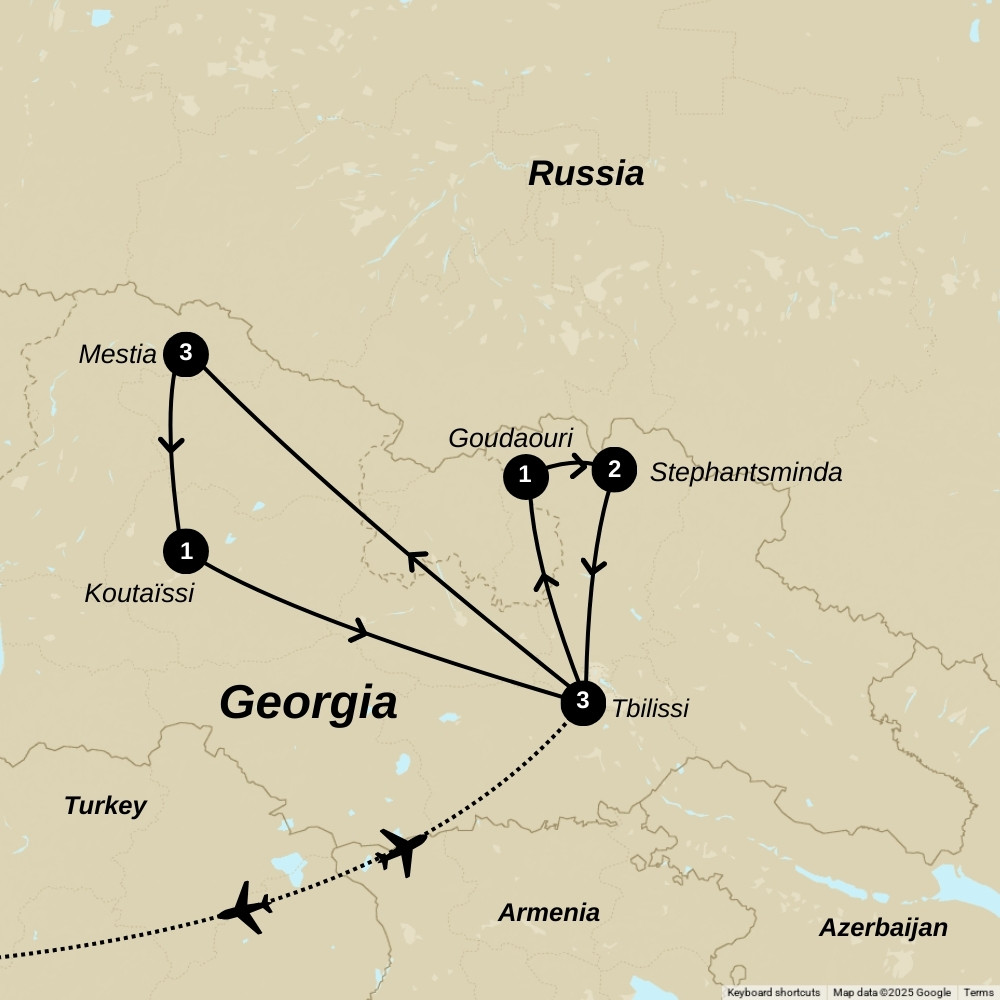




-
Day 1
Tbilisi
Arrival. Transfer to the hotel.
Overnight in Tbilisi.
Hotel: Ibis Tbilisi Stadium (or similar) -
Day 2
Tbilisi - Gudauri
Today we visit the colorful and lively capital of Georgia - the historic old town of Tbilisi lies at the foot of the Narikala Castle from the 4th century and enchants every visitor with its romantic alleys, colorful squares and the many nearby sights that bear witness to the cultural and religious diversity that have always characterized Tbilisi due to its geographic location. On both sides of the river Mtkvari there are traditional houses with the typical colorful wooden balconies. Ascent to Narikala Fortress by cable car and walk along the botanical garden to the city waterfall and the focal point of the old town, the sulfur baths district with the hot springs that gave the city its name as "the warm city". Continue to the Sioni Cathedral, Ancishati Church and Freedom Square.After a detailed city tour we drive along the old manor road on the way we visit the Ananuri Fortified Church (17th century) which is picturesquely situated above the Zhinwali Reservoir. The main church admires us with rich relief decorations and inside is decorated with beautiful frescoes and icons.Via the Cross Pass you finally reach the Gudauri ski area (2200 m).
Overnight in Gudauri.
Hotel: Gudauri Inn (or similar) -
Day 3
Truso Gorge - Stepantsminda
If you want to feel the real charm of "Wild Caucasus", then you should visit the unique Trusso Valley, which is a pure harmony of huge mountains, untouched nature and old villages. White and reddish travertines that we see along the way are very impressive natural treasures. After an extraordinary trek, we continue to Stepantsminda over the Cross Pass 2395 m. The scenic landscape, wild rivers and snowy peaks will accompany us.
Note: The Trusso Gorge is at an altitude of about 2000 m.
Ascent & descent 467m, walking time 5.5 hours.
Overnight in Stepantsminda.
Hotel: Chemodani Kazbegi (or similar) -
Day 4
Village Juta - Mt. Chaukhebi - Stepantsminda
Today we drive through the beautiful Sno valley to the village of Juta (2270). A winding road hugs the mountains where the small and exotic village of Juta awaits travellers. With its old-fashioned lifestyle, this village continues to amaze its guests to this day. Surrounded by the high mountains, it is isolated from the outside world for half a year. Visiting this village is a great experience. From Juta we drive through the green meadows towards Mount Chaukhebi (3842), which stretches out of the ground like a huge ridge and creates an impressive panorama. Our destination will be near the small green lake. Mountain rivers and colorful flowers accompany us all the way. In June, the white rhododendron blooms in the fields. We have a picnic near the small, blue mountain lake and then make our way back.
Ascent & descent 400m, walking time 4.5 hours
Overnight in Stepantsminda.
Hotel: Chemodani Kazbegi (or similar) -
Day 5
Gregety Trinity Church - Tbilisi
In the morning we will get the Gergeti Trinity Church (2170 m.) by hiking. From here we get the best view of the beautiful area. The undisputed star of Stepanstminda is the 5047 m high mountain Kazbegi, which is also called "white queen". If we are lucky and the weather cooperates, then we get unforgettable views of the white giants. Ascent & descent 470 m, walking time 3.5 hours After the trek we drive back to the land of the Old Military Road of Georgia and visit the ancient capital and religious center of East Georgia Mtskheta. In Mtskheta we visit the old capital of the country, which is picturesquely situated at the confluence of the two rivers - Mtkvari and Aragvi. Here we visit the Jvari Church - an excellent example of early Georgian architecture (6th century) and the mighty Svetitskhoveli Cathedral (11th century). The two churches are on the UNESCO World Heritage List.
Overnight in Tbilisi.
Hotel: Ibis Tbilisi Stadium (or similar) -
Day 6
Zugdidi Train Station - Mestia
Today we enjoy our trip in a different way. We take the Georgian Railway to West Georgia in Zugdidi. When we reach Zugdidi, we will be picked up from the train station and continue to Svaneti. Today we get ready for the most beautiful part of the journey - the journey to Svaneti. Svaneti is lonely and remote. This is the region where carpets of flowers and colorful butterflies tumble - ringed by some of the highest, most spectacular peaks in the Caucasus. White glaciers, medieval defense towers and untouched nature will not leave anyone indifferent. The road up to the mountains opens the beauty of the high hills of the Greater Caucasus and deep into the hidden canyons of the rivers.
Overnight in Mestia.
Hotel: Bapsha Guesthouse (or similar) -
Day 7
Koruldi Lake - Mestia
This morning we trek from Mestia to the Koruldi Lakes - at the foot of the two-headed mountain Ushba (4700m). On the way we will see different peaks and glaciers: Tetnuldi (4800m), Lyla (4008m), Chatini (4012m), Banguriani (3838m) and get a magnificent view of Mestia. When we reach small mountain lakes, a 360-degree panoramic view of the Caucasus opens around us. We will return to Mestia by the same route.
Ascent & descent 1400 m, walking time 7 hours
Note: it is possible to shorten the hiking time and drive half way by 4x4WD (extra cost 70 EUR)
Overnight in Mestia.
Hotel: Bapsha Guesthouse (or similar) -
Day 8
Village Ushguli - Shkhara Glacier - Mestia
After breakfast, drive to Ushguli by Gelenderwagen 4x4. The (UNESCO World Heritage) is at 2,400 m altitude and is therefore one of the highest places in Europe. 46 fortified towers and small castles, each of which is inhabited by a large family, still testify to the fortifications of this village. The towers consist of three to four floors, which house the stables and living quarters of up to 80 people. Trek from Ushguli village to the foot of Shkhara, the highest glacier in Georgia. The silhouettes of the defense towers of Ushguli stand out against the white wall of Georgia's highest mountain. You hike to the glacier of the third-largest peak of the Caucasus through the valley of the Inguri, which is strewn with flowers in early summer. After the trek visit a beautiful monastery in Ushguli - Lamaria (12th c.) Then drive back to Mestia.
Hiking time - 6 hours
Ascent / descent: 350 m
Overnight in Mestia.
Hotel: Bapsha Guesthouse (or similar) -
Day 9
Martvili Canyon - Kutaisi
Drive to West Georgia, we drive from Mesita to Kutaisi via Samegrelo region. On the long way from Mestia to Kutaisi, to stretch your legs a bit, visit the beauty of the Samegrelo region, the Martvili Canyon, there you will go in a rubber boat (15 min) and then walk through the shady forest. (500 meters long) Then we drive to Kutaisi. According to Greek legend, Kutaisi, whose history dates back to the second millennium BC, was the capital of the mythical kingdom of Colchis, where the Golden Fleece was kept.
Overnight in Kutaisi.
Hotel: Qeti-dato Kutaisi (or similar) -
Day 10
Tbilisi
This morning we will have a little walk in the center of Kutaisi and then we will drive to Gori on the ancient Silk Road. Visit to the ancient cave city of Uplistsikhe (6th century BC) Uplistsikhe was a pagan religious center in the country and an important point on the famous Silk Road. Ancient caves are still very well preserved today. In the late afternoon we drove to Tbilisi.
Overnight in Tbilisi.
Hotel: Ibis Tbilisi Stadium (or similar) - Day 11 Return Transfer to TBS Airport. Departure.
Meet & Assist at the airport after luggage collection (by only driver; not accompanied by guide)
Transfer back from the hotel to the airport by driver
English-speaking guide during the sightseeing visits
Overnight at above mentioned hotels
Meals as mentioned above
AC modern transportation during the excursions (size adapted according to the number of guests)
Entrance Fees to the sites mentioned in the itinerary
1 bottle (1 l) of water in the vehicle
Local taxes
Exclusions
Insurances;
Flights
Airport-hotel-airport transfer without guide
Lunches and Dinners; that are mentioned at the itinerary as included
Personal expenses (phone calls; beverages; …)
Trekking equipment
Tips for drivers and tour guide; If the service is good we recommend to tip: Guide: starting from 3-4 EUR/USD per person per day; Driver: starting from 2-3 EUR/USD per person per day
Porters in the hotels and at the airport
Georgia – Traveling in Georgia
General Overview
Georgia, known as სáƒáƒ¥áƒáƒ თველრ(Sakartvelo) in Georgian, is a country in the Caucasus region, bordering the eastern coast of the Black Sea. Located at the crossroads of Eastern Europe and Western Asia, it is widely regarded as an integral part of Europe from a cultural, historical, and political perspective. This unique position has shaped a distinct national identity, influenced over centuries by both Eastern and Western civilizations that have passed through its territory.
The capital city, Tbilisi, is the political, cultural, and economic heart of the country. Georgia covers an area of 69,700 km². The official language is Georgian, an ancient language with a unique alphabet. The local currency is the Georgian lari (GEL), with an exchange rate of approximately 1 Canadian dollar to 1.97 lari. The international dialing code is 995. Electricity runs on 220 V, and the country operates on a time difference of nine hours ahead of Montreal.
Did You Know…
Georgia is one of the most mountainous countries in Europe, with nearly 70% of its territory made up of rugged terrain. To the north, the Greater Caucasus range features peaks rising above 5,000 meters, while the Lesser Caucasus in the south offers a remarkable variety of landscapes, from volcanic plateaus to lush valleys. This dramatic topography greatly contributes to the country’s natural richness.
Georgia is also recognized as the cradle of global winemaking. Archaeological discoveries have confirmed that wine production dates back more than 8,000 years. The traditional winemaking method using qvevri—large clay vessels buried underground—is still practiced today and is listed as UNESCO Intangible Cultural Heritage. Georgian wine, produced from indigenous grape varieties, is deeply intertwined with national identity.
The country is also home to an extraordinary natural record: the Krubera Cave, located in the Arabika massif, is the deepest known cave in the world, reaching more than 2,197 meters underground. This geological marvel attracts speleologists and scientists from around the globe.
Tbilisi
Tbilisi is the main gateway for travelers discovering Georgia. Built along hillsides and crossed by the Kura River, the capital immediately charms visitors with its warm atmosphere and eclectic character. Often described as a large village at heart, its winding streets lined with colorful wooden balconies sit alongside majestic religious buildings, Oriental-inspired architecture, and imposing remnants of the Soviet era.
Overlooked by the ancient Narikala Fortress, Tbilisi invites exploration at a leisurely pace. Visitors will also discover the famous sulfur baths, a legacy tied to the very founding of the city, whose name literally means “warm place.” Tbilisi is a vibrant, creative, and deeply endearing capital.
Cave Cities
Faced with a largely mountainous landscape, Georgians learned early on how to adapt to rock and stone. Over centuries, they carved cities, places of worship, and refuges directly into cliffs and mountainsides. These cave sites now rank among the most spectacular landmarks in the country.
The Vardzia Monastery, located in southern Georgia, is undoubtedly the most impressive. Carved into a rock face, it once contained nearly 3,000 caves used as dwellings, churches, and passageways. Uplistsikhe, one of the oldest cave cities in the Caucasus, is believed to have housed up to 20,000 inhabitants and offers a fascinating glimpse into ancient ingenuity.
Svaneti
Svaneti is a high-mountain region listed as a UNESCO World Heritage Site. Isolated for centuries due to its difficult terrain, it has preserved a unique culture and set of traditions. Its dramatic alpine landscapes are dotted with villages dominated by medieval stone towers, iconic symbols of the region.
Once home to the Svans, Svaneti experienced Byzantine influence before becoming a stronghold of Orthodox Christianity. Today, it continues to captivate travelers seeking authenticity, breathtaking hikes, and a way of life closely connected to nature.
Kutaisi
Georgia’s second-largest city, Kutaisi, offers a peaceful and authentic atmosphere far removed from the bustle of the capital. Surrounded by nature, it charms visitors with its elegant city center and rich historical heritage. The Bagrati Cathedral, with its green rooftops, overlooks the city, while numerous Orthodox churches and the nearby Motsameta Monastery highlight the region’s spiritual importance. Kutaisi is an ideal stop on a journey through Georgia.
Monasteries
Georgia is inseparable from its monasteries, many of which are perched in breathtaking natural settings. These places of worship, true pillars of national identity, are scattered across mountains and valleys. The David Gareja Monastery, near the Azerbaijani border, impresses with its isolation and mystical atmosphere. The Alaverdi Monastery recalls a time when Georgia stood at the frontier between the Christian and Muslim worlds.
Sighnaghi
Nestled in the heart of the Kakheti wine region, Sighnaghi is often referred to as the “City of Love.” Its romantic charm, cobblestone streets, and panoramic views over the Alazani Valley make it a popular destination for couples. The town also features several cultural sites, including the Bodbe Monastery and a local history museum offering insight into Georgia’s heritage.
Kazbegi
In the north of the country, the Kazbegi region—centered around the village of Stepantsminda—is one of Georgia’s most beautiful mountain areas. Dominated by Mount Kazbek, it serves as a prime starting point for hikes in the Greater Caucasus. The wild, majestic scenery perfectly embodies Georgia’s mountainous identity.
Seaside Resorts
While Georgia is renowned for its mountains, it also enjoys privileged access to the Black Sea. Batumi, the country’s most famous seaside resort, captivates visitors with its lively atmosphere and modern architecture blended with historic landmarks. Beaches, seaside promenades, and vibrant nightlife reveal a different side of Georgia.
Ski Resorts
Georgia’s mountains are also well suited for winter sports. Bakuriani, a historic resort in the Lesser Caucasus, was a popular destination during the Soviet era. Today, Gudauri, located in the Greater Caucasus, is attracting a growing number of ski enthusiasts thanks to its modern facilities and spectacular scenery.
Gori
The birthplace of Joseph Stalin, Gori is a must-see for history enthusiasts. The museum dedicated to him has remained largely unchanged since 1959, offering a striking glimpse into the Soviet era. Despite its turbulent past, Gori maintains a pleasant atmosphere and pairs well with a visit to nearby Uplistsikhe.
The Wine Route
Exploring Georgia’s wine route, particularly in Kakheti, offers an authentic perspective on the country. Family-run vineyards continue to use ancestral methods and welcome visitors for tastings rich in tradition and cultural exchange. Wine is inseparable from Georgian hospitality and the spirit of sharing.
Cuisine
Georgian cuisine is generous, welcoming, and deeply rooted in local culture. Influenced by Asian, Eastern, and Western traditions, it stands out for its abundant use of walnuts, cheeses, spices, and fresh produce. It appeals equally to meat lovers and vegetarians.
Typical Dishes
Khachapuri is the undisputed symbol of Georgian gastronomy. This soft bread filled with melted cheese and often topped with an egg is found everywhere in the country. Khinkali, large dumplings filled with meat or vegetables, are another staple. Churchkhela, a sweet made of nuts coated in grape juice, is both popular and delicious. Dishes such as badrijani and pkhali highlight vegetables and walnuts, offering refined and flavorful alternatives.
Beverages
Wine holds a central place in Georgian culture, with meals often accompanied by ritual toasts. Local grape varieties such as Saperavi and Rkatsiteli are renowned far beyond the country’s borders. Chacha, a grape-based spirit, is the national drink, appreciated for its strength and aromatic profile.
Shopping and Souvenirs
Georgia offers a wealth of authentic souvenirs. Local spices, traditional sauces, sweets like churchkhela, dried fruits, Georgian tea, and clay pottery are among the most popular purchases. Handmade Minankari cloisonné enamel jewelry is also highly sought after, as are works by local artists found in markets and flea markets throughout Tbilisi.
Safety
Georgia is considered a safe destination for travelers. As elsewhere, basic vigilance with personal belongings is recommended, especially in the evening. Overall, crime rates remain lower than in many neighboring countries.
Health Advice
Tap water is not potable, and bottled water should be consumed at all times. Basic food safety precautions should be observed, and medical insurance is strongly recommended. Canadian health authorities advise vaccinations for hepatitis A and B, traveler’s diarrhea, rabies, influenza, and COVID-19.
Climate
Georgia enjoys a diverse climate due to its geography. Coastal regions experience a subtropical climate, while mountainous areas endure harsh winters. Spring and autumn are generally the best seasons to visit, offering pleasant temperatures and landscapes in bloom or vibrant fall colors.
Religions and Beliefs
Georgian Orthodox Christianity overwhelmingly dominates religious life. Adopted in the 4th century, it makes Georgia one of the world’s earliest Christian nations. The Georgian Orthodox Church continues to play a central role in society, alongside Muslim communities and other religious groups.
Etiquette and Customs
Hospitality is a fundamental value in Georgia. Welcoming a guest is considered an honor, and meals often involve long toasts led by a tamada. Respect for elders, a strong sense of family, and conviviality are central to social life. Neat attire is appreciated, especially during religious or family events. Music, dance, and traditional celebrations shape daily life and reflect Georgians’ deep attachment to their cultural heritage.
Name: Trekking in Georgia
Brand: Pathways of the World
Quality: Tourist Class
Tour Type: Self Drive
Start City: Tbilisi
End City: Tbilisi
Vacation Overview:
Georgia is a captivating destination that offers a perfect blend of ancient history, stunning landscapes, and vibrant culture. Nestled between Europe and Asia, this small country boasts dramatic mountains, lush valleys, and charming villages. Travelers can explore the UNESCO-listed city of Bagrati, taste world-renowned wines from the country’s millennia-old winemaking tradition, or hike through the picturesque Caucasus Mountains. With its warm hospitality and rich heritage, Georgia is an unforgettable journey for those seeking adventure, history, and unique experiences.