



-
Day 1
Arrival in Nairobi
Upon arrival, clients will be met and transferred to the Hotel Hilton Garden Inn for the night in standard room, breakfast included.
Hotel (superior): Hilton Garden Inn -
Day 2
Nairobi - Aberdares National Park
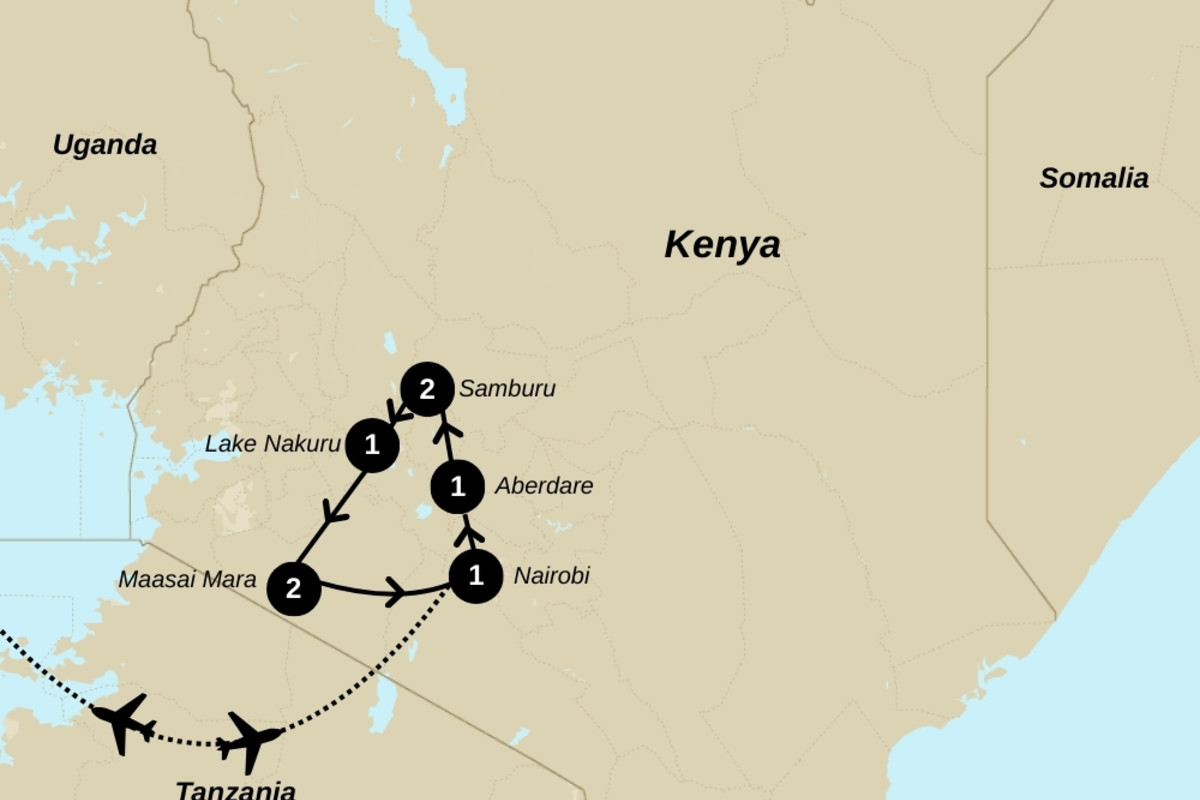
After breakfast, meet your safari driver at the hotel reception and depart to Aberdares National Park. Arrive, check in and lunch at Aberdares Country Club. Aberdares is home for beautiful scenery, magnificent waterfalls, steep forests, and open moorlands. The park is a natural habitat for variety of wildlife such as Elephants, Rhinos, Buffaloes, spotted hyaenas, olive baboons and many species of birds. Enjoy afternoon game drives till sunset. Overnight at The Ark Lodgeor similar ****
Hotel (superior): The Ark Lodge -
Day 3
Aberdares - Samburu National Reserve
After breakfast depart to Samburu, heading north, through some breathtaking scenery dotted with rushing mountain streams and fields of tea and coffee. Arrival at the lodge in time for lunch and then depart for an afternoon game drive returning to the lodge as the sun sets. Dinner and overnight at the Samburu Intrepids Camp or similar
Hotel (superior): Samburu Intrepids -
Day 4
Samburu
Morning and afternoon game drives. All meals at the camp. The reserve is reach in wildlife with fame for abundance in rare northern specialist species such as the Grevy Zebra, Somali Ostrich, Reticulated Giraffe, Gerenuk and the Beisa Oryx. Large predators such as the Lion, Leopard and Cheetah are an important attraction Dinner and overnight at Samburu Intrepids Camp or similar.
Hotel (superior): Samburu Intrepids -
Day 5
Samburu - Lake Nakuru
After breakfast at the lodge, depart to lake Nakuru national with a lunch stop enroute. There will be a stop at Thompson Falls Arrive, check in at Lake Nakuru Sopa Lodge. There will be an afternoon game drive returning to the lodge as the sun sets. The national park, known for its birdlife, offers a possibility to view flamingoes. It is also home to Black and White rhinos as well as the endangered Rothschild Giraffe Overnight at Lake Nakuru Sopa Lodge or similar
Hotel (superior): Lake Nakuru Sopa -
Day 6
Lake Nakuru - Masai Mara
After breakfast, depart to Masai Mara Game Reserve. Heading across acres of rolling wheat and barley farms to Narok, the district headquarters of this part of Maasailand. From here cross the vast plains on the floor of the Rift Valley whilst keeping an eye out for herds of giraffe and gazelle before heading up the rift escarpment. You will arrive at your lodge in time for lunch and later enjoy time for relaxation before setting off back into the park for your afternoon game drive in the park Return to the lodge as the sun sets.
Hotel (superior): Zebra Plains Mara Camp -
Day 7
Masai Mara
Full day game drive in the Masai Mara. The landscape of huge rolling plains, woodlands, riverine forests, hills are home to millions of animals. Its famous Mara River plays host to the annual wildebeest migration spectacle. The reserve is also a bird’s paradise with over 450 different species. Return to the lodge as the sun sets.
Hotel (superior): Zebra Plains Mara Camp - Day 8 Masai Mara - Nairobi Breakfast at the lodge then drive back to the capital city Nairobi. Arrive for lunch at the celebrated Carnivore Restaurant. After lunch you will be transferred to airport for your international flight, booked by agent. End of safari Services.
Included
Meet and greet services
Airport Transfers in safari minibus or coach on sharing basis
Safari transport in a 4×4 safari JEEP with pop-up roof maximum 6 passengers
Services of a professional English-speaking driver-guide
Guaranteed window seat
Breakfast at the Nairobi hotel on day 1
Full board breakfast lunch & dinner during safari
All Park fees entry fees
All local government taxes
Exclusions
Visas and international flights
Driver-guide gratuities
Drinks dining rooms tips porterage
Personal travel baggage and medical insurance
Telephone bill laundry and any items of a personal nature
TRAVELING TO KENYA
Kenya is one of East Africa’s true gems, a country that inspires travelers with the vastness of its landscapes, the richness of its wildlife, and the diversity of its cultures. Renowned worldwide for its safaris, Kenya also offers stunning beaches along the Indian Ocean, tropical forests, legendary mountains, and endless savannahs. With more than fifty national parks and reserves, it is one of the best places on Earth to observe the famous Big Five: the lion, leopard, elephant, black rhinoceros, and African buffalo.
Yet Kenya is far more than its iconic wildlife. Traveling through the country also means meeting communities that have preserved ancestral traditions, discovering unspoiled nature, and feeling a deep connection to the great African outdoors.
The capital city is Nairobi, a major economic and cultural hub of East Africa. Kenya covers an area of 582,646 km². The official languages are Swahili and English, and the local currency is the Kenyan shilling. The country operates on a time zone seven hours ahead of Montreal. The international dialing code is +254, and the electrical voltage is 240 V.
DID YOU KNOW…
Kenya is the only African country to have established a dedicated armed force solely responsible for the protection of wildlife. Its territory is home to Mount Kenya, which rises to 5,199 meters and is the second-highest peak in Africa after Mount Kilimanjaro. The country also plays a key economic and financial role in East Africa, largely driven by agriculture and tourism, two major pillars of its economy. This richness is further enhanced by Kenya’s exceptional human diversity, with more than forty ethnic groups speaking over sixty different languages.
SHABA NATIONAL RESERVE
Located in northern Kenya, Shaba National Reserve forms a remarkable natural trio with the Samburu and Buffalo Springs reserves. This arid and striking landscape is particularly known for sightings of giraffes and the endangered Grevy’s zebra. The regular presence of rangers, researchers, and wildlife photographers highlights the ecological importance of the area. Shaped by a river and dramatic volcanic rock formations, the scenery offers a powerful blend of raw wilderness and tranquil beauty.
SAMBURU
The Samburu region is inseparable from the Samburu people, known for their ancestral traditions and semi-nomadic way of life. Visitors have the opportunity to learn about the customs of this warrior community, their social structures, dwellings, and survival techniques in a sometimes harsh environment. Traditional dances and vibrant beadwork, worn by both men and women, lie at the heart of this cultural experience.
Samburu National Reserve stretches along the Ewaso Ng’iro River, a vital lifeline in the heart of the savannah. It allows travelers to observe a wide variety of wildlife in a more intimate setting than the large southern parks, offering an authentic and memorable safari experience.
NAKURU
Nakuru National Park was established in 1961 to protect the alkaline lake of the same name, located in the Great Rift Valley. The lake is famous for hosting, at certain times of the year, hundreds of thousands of pink flamingos, creating a breathtaking natural spectacle. Beyond these iconic birds, the area supports a remarkable diversity of birdlife and serves as an excellent introduction to safari for travelers discovering Kenya.
Nearby lies Hell’s Gate National Park, whose name contrasts sharply with its reality. Situated close to Lake Naivasha, this spectacular park is known for its gorges, cliffs, and impressive rock formations. Unlike most parks, visitors can explore it on foot, by bicycle, or even on horseback, offering a more immersive and dynamic way to experience Kenya’s natural environment.
MASAI MARA
The Masai Mara Reserve is undoubtedly Kenya’s most iconic destination. Located in the southwest of the country along the border with Tanzania, it is characterized by vast rolling plains crossed by the Mara and Talek rivers. It is here that one of the world’s greatest natural spectacles takes place: the Great Migration, during which millions of wildebeest, accompanied by zebras and gazelles, traverse the savannah while facing constant threats from predators.
The Masai Mara is also a prime location for observing lions, cheetahs, leopards, and elephants in their natural habitat. The presence of the Maasai people, who have lived in harmony with wildlife for centuries, adds a powerful cultural dimension to the visit.
KAKAMEGA
Kakamega Forest is Kenya’s last remaining primary tropical rainforest. Located in the western part of the country, it is a true sanctuary of biodiversity. This vast forest can be explored on foot or by bicycle and offers complete immersion in a lush ecosystem. Visitors can stay in campsites or nature-integrated lodges, an experience particularly appreciated by travelers seeking tranquility and authenticity.
MOMBASA ISLAND
Mombasa Island is a coral outcrop connected to the mainland by road. It is home to the historic heart of the city of Mombasa, shaped by strong Swahili and Arab influences. Beyond its rich cultural heritage, the island is known for its lively atmosphere, markets, beaches, and events, including the famous Mombasa Carnival held in November. It is an ideal destination for discovering a different side of Kenya, one oriented toward the ocean and cultural exchange.
CENTRAL PROVINCE
Central Province is dominated by the majestic silhouette of Mount Kenya, the highest peak in the country. This mythical mountain, surrounded by a national park listed as a UNESCO World Heritage Site, offers some of Kenya’s most breathtaking scenery. Its slopes are home to unique flora and fauna, while hiking trails lead to spectacular viewpoints.
The Ewaso Ng’iro River, fed by Mount Kenya’s glaciers, flows through the region and attracts kayaking and hiking enthusiasts. Whether seeking adventure or contemplation, this area is a must for anyone wishing to explore the country’s natural heart.
CUISINE
Kenyan cuisine reflects the country’s cultural diversity and bears the influence of Indian and Swahili traditions. Historically designed to feed large populations with limited resources, it is based on simple, hearty, and accessible dishes. Corn, beans, rice, vegetables, and meat form the foundation of many meals.
Among the most emblematic foods, ugali holds a central place. This cornmeal staple accompanies nearly every dish. Fresh salads such as kachumbari, sautéed greens like sukuma wiki, coconut-based bean stews, chapati bread, and spiced rice dishes such as pilau illustrate the richness and generosity of local gastronomy. Along the coast, coconut- and fish-based dishes like wali wa nazi reflect the influence of the Indian Ocean.
DRINKS
Although Kenya is internationally recognized for the quality of its coffee and tea, the most widely consumed beverage is chai. This milk tea, slowly brewed and generously sweetened, is omnipresent in daily life and represents a true social ritual.
SHOPPING AND SOUVENIRS FROM KENYA
Kenyan souvenirs are deeply rooted in local craftsmanship. Maasai beadwork, with its symbolic colors, is among the most iconic items. Wooden carvings, often depicting African wildlife, are also highly sought after. In Nairobi, the Kitengela artistic community stands out for its unique creations made from recycled glass. Baobab fiber bags, Kenyan Arabica coffee, and decorative masks complete a rich and varied artisanal offering, ideal for bringing home an authentic keepsake.
SAFETY
Traveling with a guide is recommended, particularly when venturing outside major cities or into national parks. As with any major destination, demonstrations may occasionally occur in urban centers. Staying informed about local news during the trip is advised.
HEALTH ADVICE
Basic hygiene practices should be observed, especially washing hands before meals. Food should be well cooked and served hot, fruits and vegetables peeled or thoroughly washed, and dairy products preferably industrially produced. A consultation at a travel health clinic several months before departure is strongly recommended to receive appropriate vaccinations.
CLIMATE
Kenya enjoys a tropical climate with alternating dry and rainy seasons. The months from July to March are generally preferred for safaris, with October being particularly favorable for observing large concentrations of wildlife.
RELIGIONS AND BELIEFS
The majority of Kenya’s population identifies as Christian, primarily Protestant and Catholic. Islam is also present, especially along the coast, alongside many traditional African beliefs that remain very much alive.
ETIQUETTE AND CUSTOMS
Kenyans place great importance on values of respect, humility, and solidarity. Community life and human relationships are central, particularly in rural areas where tradition and modernity coexist harmoniously. Attentive travelers will discover a welcoming people, proud of their heritage and deeply connected to their roots.
Name: Wonders of Kenya
Brand: Pathways of the World
Quality: First Class
Tour Type: Wildlife
Start City: Nairobi
End City: Nairobi
Vacation Overview:
A complete safari package to discover the wonders of Kenya in the best wildlife reserves in Kenya namely Masai Mara, Samburu, Aberdares, and Lake Nakuru