



Trip Start
Trip End
Price (CAD)
Departing On
Returning On
Without Flight
Call to speak with one of our Tour Experts 1-877-230-8747
-
 Heather Felicex7338
Offline
Heather Felicex7338
Offline
-
 Victoria Guestx7121
Offline
Victoria Guestx7121
Offline
-
 Jairus Mausx7365
Offline
Jairus Mausx7365
Offline
-
 Brenda Moranx7218
Offline
Brenda Moranx7218
Offline
-
 Robyn Murrayx7215
Offline
Robyn Murrayx7215
Offline
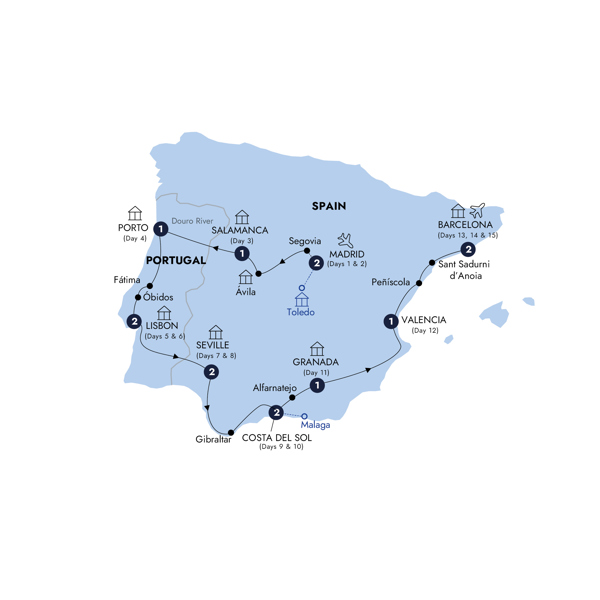
- Day 1 Welcome to Madrid Arrive in Madrid, Spain’s capital since the 16th century, where the grand layout of the Bourbon period meets older barrios built around markets and neighborhood squares. Meet your Travel Director and your small group over dinner in a local restaurant, sharing a meal and getting to know the people you’ll be traveling with across Spain and Portugal. Locations Visited: Madrid ES.
- Day 2 Madrid of the Bourbons Explore Madrid’s central neighborhoods with your Local Expert, moving through the Old Quarter that grew around the city’s original medieval fortress and later expanded under the Habsburgs. Continue to the Prado Museum, founded in 1819 and recognized for its extensive European collection. You’ll join an art historian to view works by Velázquez, Goya, Titian, Rubens and others, gaining clear context for the artists who shaped Spain’s cultural record. Locations Visited: Madrid ES.
- Day 3 Segovia and Golden Salamanca Travel to Segovia and walk its historic streets with a Local Expert, viewing the Alcázar fortress that once guarded the approach to the Castilian plain. After your stop at the Alcázar, you’ll continue to the Roman aqueduct, a 1st-century engineering work that supplied the city with water for centuries. From here, you’ll journey on to Salamanca, passing the medieval walls of Ávila. On arrival, your inimitable Local Expert will guide you to Plaza Mayor and the university buildings that shaped the city’s academic life from the 13th century. Locations Visited: Madrid ES, Segovia ES, Avila ES, Salamanca ES.
- Day 4 Porto, Grande Dame on the Douro Cross into Portugal and travel to Porto, a city shaped by its medieval Ribeira district and long history of Atlantic trade. Begin at the wine cellars of Vila Nova de Gaia, where port has been stored and aged since the 18th century, and join a guided tasting that introduces the region’s unmistakable flavors, from the golden tawny to deep red rubies. Continue with an orientation tour led by your Travel Director through the key riverside quarters and stepped streets. Afterwards, you’ll have time to explore spots such as the São Bento station’s tile panels, the riverside lanes of the Ribeira, or the compact merchants’ quarters around Clérigos Tower. Locations Visited: Salamanca ES, Porto PT.
- Day 5 Holy Fátima, Ancient Óbidos and Lisbon Travel south to Fátima, Portugal’s most renowned place of pilgrimage, marked by the Sanctuary complex built after the reported apparitions of 1917. Continue to Óbidos and walk within its medieval walls, moving through narrow lanes and whitewashed houses that reflect the town’s fortified character. Try the local cherry liqueur, ginja, traditionally served in small chocolate cups, before traveling on to Lisbon, a coastal capital shaped by Moorish foundations and centuries of maritime trade. You may choose to join an Optional Experience and dine at a family-run restaurant known for its traditional Portuguese seafood. Locations Visited: Porto PT, Fátima PT, Obidos PT, Lisbon PT.
- Day 6 Lisbon and the Age of the Great Discoveries Explore Lisbon with a Local Expert, beginning in the Baixa’s Lower Town and the broad Pombal Square, rebuilt after the 1755 earthquake. Continue into the Belém Quarter to view the Monument to the Discoveries and the Belém Tower, and pause to try pastéis de Belém, the custard tarts first baked by Jerónimos monks in the 19th century. Visit the National Coach Museum to see its collection of royal carriages from the 16th to 19th centuries. Later, enjoy free time to follow the riverfront paths of Belém, browse Chiado’s shops or take the tram up to Alfama. Locations Visited: Lisbon PT.
- Day 7 The Algarve and on to Seville Depart Portugal this morning and travel south into the Algarve, pausing in one of the region’s coastal towns for lunch. Long shaped by fishing, trade and a warmer Atlantic climate, the Algarve brings a different character to the day before you continue east and cross into Spain. From here, travel through the landscapes of Andalucía and arrive in Seville later in the afternoon. The evening is at leisure in Seville, giving you the chance to make the most of the city after dark. You might stroll through Santa Cruz, settle into a tapas bar in Triana where flamenco has deep roots, or head to a rooftop terrace for views across the historic center. Locations Visited: Lisbon PT, The Algarve PT, Seville ES.
- Day 8 Flamenco and History in Seville Meet your Local Expert and explore Seville, viewing the symbolic Giralda bell tower and the Moorish-inspired María Luisa Park, with its tiled fountains, pavilions and ponds, before seeing the exterior of Seville Cathedral and walking through the former Jewish quarter. Spend the rest of the morning at leisure with time to visit the Plaza de España or wander the lanes around the riverfront near Torre del Oro. In the afternoon, take part in a MAKE TRAVEL MATTER® Experience at the Cristina Heeren Foundation, where a flamenco instructor will guide you through the basic rhythms and movements taught at this renowned school dedicated to preserving Andalusia’s artistic traditions. Locations Visited: Seville ES.
- Day 9 Head for Gibraltar and the Costa del Sol Cross into Gibraltar for a closer look at this unique slice of the peninsula. Head up the Rock with a Local Expert and explore St. Michael’s Cave — a vast limestone chamber shaped by thousands of years of water and mineral movement. Keep an eye out for the Barbary macaques that live here under protected status. You’ll then follow the road along the Costa del Sol, tracing the shoreline past small coves and resort towns before rolling into Torremolinos for the evening. Locations Visited: Seville ES, Gibraltar GI, Costa del Sol ES, Torremolinos ES.
- Day 10 At Leisure on the Costa del Sol A free day on the Costa del Sol gives you room to set your own pace. Wander Torremolinos’ old fishing quarter in La Carihuela, stopping for fried pescaíto or grilled sardines along the promenade. Walk the beachfront path towards Benalmádena, or head into Málaga for its Alcazaba, cathedral and small neighborhood markets. If you prefer to keep things simple, spend the day drifting between cafes, shade and sea. Locations Visited: Torremolinos ES.
- Day 11 Dining with Locals and the Alhambra Travel into the hills around Alfarnatejo and walk the small town center with your Travel Director, passing quiet squares and the Iglesia del Santo Cristo de Cabrilla. You’ll head out to one of the area’s oldest olive groves to see how the trees are tended on this dry mountain terrain. At a rural mill, taste a few of the local oils with fresh bread and hear how each blend changes with the harvest and the age of the trees. Sit down to a home-cooked lunch with a local family — simple Andalusian dishes, seasonal produce and a chance to hear how life moves in this part of the region. Afterwards, continue to Granada for a guided visit to the Alhambra with a Local Expert, stepping through courtyards, carved plasterwork and gardens that trace the long Nasrid period of the city. Locations Visited: Torremolinos ES, Alfarnatejo ES, Granada ES.
- Day 12 On to Valencia Upon arrival to Valencia stop to see the City of Arts and Sciences, the striking cultural complex built along the former Turia riverbed after the river was diverted in the 20th century. Continue through the ancient city gates to the Old City. You may wish to browse the shops, stop for a drink or take a short walk through the city center before dinner. This evening, join your group in a local restaurant for Paella Valenciana, the rice dish that has its roots in the fields and kitchens of this region. Locations Visited: Granada ES, Valencia ES.
- Day 13 Along the Coast to Peñíscola and on to Barcelona Follow the coast north to Peñíscola and where you’ll pause to view the 14th-century castle built by the Knights Templar, set high above the sea on a rocky headland. Continue along the Costa Dorada towards Sant Sadurní d’Anoia, long recognized as the heart of Spain’s cava industry. Stop at a local bodega for a light lunch and a tasting, with an explanation of how the traditional method — secondary fermentation in the bottle, long ageing on the lees and hand riddling — shapes the character of each style. Travel onwards with your group to Barcelona, crossing into the wider metropolitan area before reaching the city center later in the day. Locations Visited: Valencia ES, Barcelona ES.
- Day 14 Barcelona Sightseeing Enjoy early access to the Palau de la Música Catalana, stepping into a Modernist concert hall to explore and enjoy an organ performance. Take a drive through Barcelona with a Local Expert along Passeig de Gràcia, where you’ll pass balconies, stonework and rooflines shaped by the Modernista architects who rebuilt the city’s identity at the turn of the 20th century. Continue into the Eixample, following the sharp grid and open junctions that make this district easy to read from above and at street level. You’ll visit the Sagrada Família and stand close enough to see the differences between Gaudí’s early stonework and the ongoing construction that rises around it. In the evening, meet your group for a final dinner, raising a glass to the days you’ve spent traveling through Spain and Portugal and the moments that stitched the trip together. *Please note that access to the basilica may be restricted for special masses, pilgrim visits or official ceremonies, and we may be unable to secure tickets to visit. Should this occur during your tour, you will visit the Hospital de Sant Pau instead, a striking example of Catalan Art Nouveau designed by Gaudí’s contemporary, Domènech i Montaner. Afterwards, join your Local Expert in the gardens surrounding the Sagrada Família and take in the extraordinary exterior of Gaudí’s iconic masterpiece. Locations Visited: Barcelona ES.
- Day 15 Depart Barcelona Transfer to the airport, saying goodbye to your Small Group and Travel Director and bringing your journey through Spain and Portugal to a close. Locations Visited: Barcelona ES.
Name: Best of Spain and Portugal - Small Group end Barcelona
Brand: Insight
Quality: Superior First Class
Tour Type: Escorted
Start City: Madrid
End City: Barcelona
Location Summary: Madrid, ES
Segovia, ES
Avila, ES
Salamanca, ES
Porto, PT
Fátima, PT
Obidos, PT
Lisbon, PT
The Algarve, PT
Seville, ES
Gibraltar, GI
Costa del Sol, ES
Torremolinos, ES
Alfarnatejo, ES
Granada, ES
Valencia, ES
Barcelona, ES
-
Highlights
- Dining Summary - 5 Dinner (D). 14 Breakfast (B). 2 Lunch (L).
- How You'll Travel - Business class coach with extended leg room. Top-rated dining, from farm-to-table to local restaurants. 4 & 5-star stays.
- Insight Experiences - Madrid: Visit the Prado Museum with an art historian who places key works within their historical setting. With your historian’s expert guidance, you’ll examine paintings by Velázquez, Goya, Titian and Rubens, noting their connection to royal patronage and the broader European tradition. Learn how the museum, founded in 1819, became a principal repository for Spain’s royal collections and major works from across the continent..
- Top Rated Highlights - Madrid: Explore Madrid’s Old Quarter with a Local Expert who outlines how the district developed from a small medieval citadel into the center of Habsburg Madrid. You’ll see the compact street grid, market squares and civic buildings that shaped the early city, and trace how each layer of expansion created the foundations of the modern capital.. Segovia: Walk Segovia’s historic center with a Local Expert who explains how the city developed at the meeting point of Roman, medieval and royal influence. View the Alcázar, a fortified complex documented from the 12th century, and examine the structure of the Roman aqueduct, whose towering granite arches carried mountain water into the city for almost two thousand years.. Salamanca: Explore Salamanca’s central streets and squares with a Local Expert, tracing the city’s rise as one of Europe’s early university centers. Study the sandstone facades around Plaza Mayor and the university buildings founded in the 13th century, including examples of Plateresque detail that mark the city’s architectural identity.. Porto: Join your Travel Director for an overview of Porto’s key districts, moving through the medieval Ribeira and the areas shaped by 19th-century trade. See everyday landmarks such as São Bento station, known for its 20,000 hand-painted azulejo tiles depicting scenes from Portuguese history, and the Clérigos Tower, a long-standing reference point in the historic center.. Obidos: Walk inside Óbidos’ medieval walls, you’ll follow a street pattern that reflects its origins as a Roman settlement later granted as a royal wedding gift in the 13th century. You’ll move through lanes lined with whitewashed houses and small churches, and sample ginja, the local cherry liqueur traditionally served in small cups. . Fátima: Explore Fátima with a focus on the Sanctuary complex established after the reported apparitions of 1917. Here, you’ll also be able to view the Basilica of Our Lady of the Rosary, the Chapel of the Apparitions and the broad esplanade built for large pilgrimage gatherings. . Lisbon: Explore Lisbon with a Local Expert, focusing on the Baixa district rebuilt after the 1755 earthquake and the broad Pombaline layout that shaped the Lower Town. Continue through the Belém Quarter to view landmarks linked to Portugal’s maritime era, including the Monument to the Discoveries and the Belém Tower, both positioned along the Tagus. . Lisbon: Visit the National Coach Museum to examine its collection of royal carriages dating from the 16th to 19th centuries. Used for state ceremonies and diplomatic events, you’ll view coaches that illustrate the shifts in artisanship, decoration and court protocol across several European courts. . Seville: Explore Seville with your Local Expert, viewing the Giralda bell tower, the exterior of Seville Cathedral and the former Jewish quarter. You’ll also see María Luisa Park, laid out for the 1929 Ibero-American Exposition, with its tiled fountains, pavilions and formal gardens reflecting the city’s layered architectural character.. Gibraltar: Join a Local Expert to get under the skin of Gibraltar, moving from the compact town center up towards the Rock. Learn how the territory’s mix of British and Mediterranean influences shows up in its streets, its military history and its daily life. . Granada: Explore Granada with your Local Expert, moving through the city streets that sit between the Albaicín’s older Moorish lanes and the broader avenues shaped in later centuries. The tour introduces you to the city’s layered history and the landmarks that sit below the Alhambra’s ridge.. Valencia: Get your bearings in Valencia’s Old City as your Travel Director points out the surviving medieval gateways and the street grid shaped by centuries of expansion.. Peñíscola: See Peñíscola’s 14th-century castle rising above the old town, set on a limestone headland that divides the shoreline.. Barcelona: Explore Barcelona with a Local Expert who sets out the city’s shape from street level — the long run of Passeig de Gràcia, the sharp grid of the Eixample and the way the skyline shifts as the Sagrada Família comes into view. The route ties together the city’s Modernista detail and its ongoing architectural change.. Barcelona: Enjoy early access to the Palau de la Música Catalana, a Catalan Modernist concert hall known for its stained-glass skylight and sculptural detail. Take in the Lluís Millet Hall and settle into the main auditorium as an organ performance fills the room. .
- Authentic Dining - Vila Nova de Gaia: Visit the wine cellars of Vila Nova de Gaia, the center of port ageing and storage since the 18th century. You’ll learn how barrel conditions, blending practices and long-standing shipper traditions define styles such as Ruby, Tawny and Vintage. Examine the link between Douro Valley production and the export houses established along this southern bank of the Douro River.. Lisbon: In Belém, try pastéis de Belém: crisp layers of pastry encasing custard complete with a dusting of cinnamon. See how the pastries follow a closely guarded recipe, and are still prepared in the same bakery that has produced them since 1837. . Torremolinos: Visit a rural mill outside Torremolinos to taste olive oils pressed from olives grown on trees that have stood in this region for generations. Try a few varieties with freshly baked bread and hear how harvest timing, soil and tree age influence the flavor. . Alfarnatejo: Share a home-cooked lunch with a local family in Alfarnatejo. Expect simple Andalusian dishes, seasonal ingredients and an easy conversation around the table. It’s a chance to see how meals are prepared and shared in this part of rural Spain, and to hear stories about the town from the people who live there. . Valencia: Sit down to a traditional paella dinner in Valencia, the city where this much-loved dish has its roots. As you dine, you’ll taste the saffron, rice and stock that define its depth of flavor, alongside the ingredients that give each paella its character, from rabbit and chicken to seafood.. Barcelona: In Sant Sadurní d’Anoia, you’ll visit a local bodega set among the vineyards that have supplied cava houses since the 19th century. A light lunch is paired with a tasting of cavas made using the traditional method, showing how bottle fermentation and ageing on the lees influence the wine’s structure and character. . Barcelona: Your final evening brings the group together around the table in Barcelona. It’s a chance to share dinner in the Catalan capital, reminisce over the days you’ve traveled and mark the end of your journey across Spain and Portugal with one last meal together. .
- MAKE TRAVEL MATTER® - Seville: The Cristina Heeren Foundation promotes the teaching and preservation of flamenco and is supported by a TreadRight Foundation grant. Meet students, learn a few basic steps and watch them perform, gaining insight into how the school trains young artists in guitar, singing and dance. Your visit directly supports United Nations Sustainable Development Goal 4: Quality Education..